digest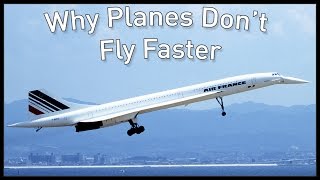
Short Summary
Main recommendation: Airlines fly at about 500–550 mph because that is the most fuel-efficient speed, not because speed is limited by engines alone. Flights have not gotten faster since the 1960s largely because cost, not speed, drives airline decisions, and the Concorde's supersonic model proved too expensive to keep flying.
Key Points
- Scheduled flight times have lengthened since 1967 (for example, American Airlines Flight 3 from JFK to LAX is scheduled 44 minutes longer), even though actual airborne times are roughly the same, because scheduled times now account for congestion and delays.
- Engine type determines efficient speed: turboprops are most efficient around 325–375 mph, turbofans around 400–620 mph, and turbojets only around 1,300–1,400 mph.
- Bypass ratio is the main driver of engine efficiency; the higher the ratio, the more thrust per unit of energy, as seen with the GE GEnx (10:1) versus the zero-bypass Concorde engine (0:1).
- Concorde's per-passenger fuel economy was about 14 mpg versus about 104 mpg on the 787 Dreamliner; Concorde seated only 100 passengers versus 291 on the Dreamliner.
- Fully flat business-class seats (introduced by British Airways in 2000) let travelers sleep across the Atlantic overnight, undercutting Concorde's time-saving appeal.
- Aircraft cost is a small share of per-flight expense, so faster flying offers airlines little savings, while fuel and speed-related drag matter more.
Details Worth Noting
- Concrete instructions: The video gives no step-by-step guidance for travelers, but it offers practical choices: expect longer scheduled flight times when comparing older schedules, and recognize that speed selling points matter mainly to consumers rather than airlines.
- Drag near the speed of sound (transonic range, Mach 0.8–1.2) makes flight both costly and unstable, which is why airlines fly either well below Mach 0.8 or above Mach 1.2; the commercial subsonic limit cited is 613.8 mph.
- Dreamliner figures: list price about $224.6 million, rated for 44,000 cycles, implying roughly $5,000 in airframe cost per flight versus over $15,000 in fuel for New York to London.
- The Concorde's last commercial flight was October 24, 2003; the video notes British Airways introduced the first fully flat business-class seat in 2000.
- The speaker frames cost as the barrier for most travelers, concluding that future efforts will focus on lowering travel costs rather than time.
Bottom Line
Commercial flight has not gotten faster because lower cost and fuel efficiency matter more to airlines and most passengers than speed, and supersonic travel proved economically unsustainable.