 digest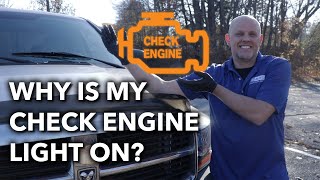
Did your check engine light come on?
Did your check engine light come on and you want to know what it means? That's what we're going to talk about in this video.
What is a check engine light?
So what is a check engine light? It is a warning indicator light that lets you know there is a mechanical or electrical problem with your vehicle, but it's not limited to just your engine. It could have to do with the traction control, ABS system, or the transmission system, even the four-wheel drive system.
Now, there are many different names for this. You could have an MIL light, which is malfunction indicator light; a DTC light, which is diagnostic trouble code light; an SES light, which is service engine soon light; or a CEL light, which is check engine light.
Based on the vehicle, your light may look different. Some vehicles have a little engine that looks like it's outlined in orange, or you could have a picture of an engine with the word "check" underneath it, or written out "service engine soon" light, or it could just be written out "check engine light," or something else.
Now, don't get this confused with a maintenance light or a service light, where you just need an oil change. Sometimes they look like a little wrench or even like an oil can.
Should you drive with a check engine light on?
Now, should you drive with a check engine light on? If the check engine light is on solid and it's not flashing, it's okay to drive with the check engine light on. Now, if the engine light is flashing, you definitely want to pull over and have the vehicle towed. You don't want to drive with a flashing check engine light. It could cause more damage and cost you more money in the long run.
Although you can drive with the check engine light on, it would be best to get it to a location where you could actually scan the vehicle and find out why the light is actually on.
Can you drive with a flashing check engine light?
[Covered in the preceding section; see the flashing light guidance above.]
Would a check engine light come on for no reason?
Now, would a check engine light come on for no reason? The answer is no. There's definitely a reason why it came on, whether it's something as simple as a loose gas cap or even the voltage being low on your battery, and your battery just needs to be charged.
So your vehicle has sensors. There's a sensor right here, there's a sensor right here, and throughout the rest of the vehicle, and computers are monitoring those sensors. When the computer sees something that isn't right, whether there's something wrong with the sensor or something wrong with the readings that the sensor is reading, that's when you're going to get your check engine light.
Will low oil cause a check engine light to come on?
Now, directly, low oil should not cause your check engine light to come on. Although, if you have a low oil level sensor that triggers a light, or even an oil pressure sensor, if the oil level is low enough that you're getting air bubbles throughout the oil pressure system, that could cause the check engine light.
Now, newer engines, like this Buick, have VVT, or variable valve timing, which is actually very sensitive to oil level. If the oil level gets down too low, it's going to affect that system, and also the timing chain system, which, if there isn't enough pressure, can cause components to wear out and cause the check engine light. But in the case that you got a check engine light because of that situation, most of the time changing the oil isn't going to fix it. The damage is already done.
What if the check engine light goes away?
Now, what if you're driving along and that check engine light that you've had on for a while suddenly goes off? What does that mean? In that case, whatever the computer was monitoring in the vehicle that failed to cause the check engine light suddenly passed.
This could have happened because of a temperature change. Maybe the engine light comes on only in cold temperatures, and when it's warm out, something seals up and it doesn't fail that test. Another situation: if you had a low voltage condition and that's what caused the check engine light to come on, like if the vehicle sat for a month or so and you started driving it, once the battery voltage is back up to par, that could have canceled out the check engine light.
Can you turn off the check engine light?
So, can you turn off the check engine light? Sure, you can turn it off. You can use a scan tool, although if you didn't diagnose anything and fix anything, most likely it's going to come back on.
To understand exactly why your check engine light came on, you're going to need a scan tool. You have to scan it, find out what codes are in the vehicle, and go from there. Just because the scan tool gives you a code doesn't mean it tells you exactly what's wrong with the vehicle. It just gives you a direction, and then you're going to have to diagnose it.
Now, after you've diagnosed the condition and completed the repair, then you can clear the check engine light and you should be good to go. You may have fixed what you thought was the problem and driven the vehicle, and a week later the check engine light comes back on.
Does the scan tool tell me what to replace on my car?
[Covered in the preceding section; see the scan tool guidance above.]
What is a readiness test?
In other situations, you may have replaced a part that requires a readiness test. What the readiness monitors do are different tests that the computer is going to run while you're driving the vehicle to make sure everything's working properly. If it doesn't pass those tests, that's when you get a check engine light.
Now, certain states have emissions tests where the vehicle actually has to be hooked to a machine and checked to see if it will pass. If those readiness monitors have not passed all their tests, then it's not going to pass inspection. So you can't just go up with a scan tool, clear your check engine light, and go get an emissions test for your state inspection.
Can I clear the check engine light to pass inspection?
[Covered in the preceding section; see the readiness monitor guidance above.]
Subscribe! | See links in description!
If you want more information about scan testing your vehicle, diagnosing, and readiness monitors, click the link in the description. If you enjoyed this video, make sure you subscribe to our channel, ring the bell, and turn on all notifications so you don't miss any of our videos.