 digest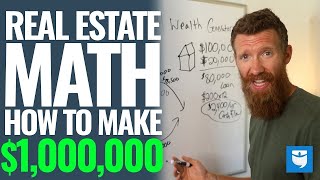
Hey, it's Brandon from BiggerPockets, and today I want to show you on this whiteboard a simple explanation of how a person can go from really almost nothing to becoming a millionaire by owning rental properties. And hey, if you find this video helpful, don't forget to click that little thumbs up button below the video. It really helps make sure more people are reached with this message. So with that, let's first get a little bit of clarification on how this real estate thing works. First of all, we're talking about buying rental properties, which means you buy a house, or maybe a duplex or an apartment building, whatever, and you rent it out.
Now, before I walk you through the math behind becoming a millionaire through real estate, I actually want to get us all on the same page, or the same board, as to the fundamentals about owning rentals, on why they're so powerful. And to do that, we're going to talk about something called the four wealth generators. The four wealth generators. Did I spell that right? Sure. All right, so these are the four things that really make owning rental properties so awesome, and when they're combined together, can make you a millionaire. Now, I talk about these a lot more in depth in my book, The Book on Rental Property Investing, which you can get on Amazon or Barnes & Noble or wherever. BiggerPockets.com says Rental Book. But hey, let me give you them right now, the quick and dirty on the four wealth generators.
Number one is going to be cash flow. So the first thing, cash flow, that's the extra money every month that a property produces in profit. It's income minus expenses. The key to that, though, is understanding expenses, because they're kind of tricky. Make sure you get all the expenses when you're calculating. But basically, this is just the money you're left with in your pocket at the end of every month.
Now, number two, appreciation. This is basically the simple truth that real estate tends to climb over time in value. Sure, things like 2008 do happen, and prices do drop sometimes, a lot. But over time, prices tend to climb. As long as you can hold on to a property long enough, you should always see appreciation. And that's why cash flow, which we just talked about a second ago, is so vital, because as long as I'm making cash flow, I can hold on to it as long as I need to, waiting for the property to climb in value.
Now, number three, the loan paydown. Normally when you buy a piece of real estate, you get a loan from a bank, which you then pay every month. But the cool thing is, over time the loan gets paid down, which means you might start owing, what's called, 200 grand, but eventually you'll own nothing. So the loan starts here and over time tends to drop what you owe on it.
And number four, the fourth wealth generator, tax benefits. For the purpose of this video, we're not going to talk a lot about tax benefits, but in real life, man, the tax benefits are huge. Like, if you made a hundred grand from real estate and your friend made a hundred grand from a job, or maybe a business they own, who do you think would end up keeping more money? You would, with real estate, way more money than your friend.
All right, so let me show you how these four wealth generators can make you a millionaire when combined together. Okay, let's just say you bought a house as a rental property. Maybe you put down 20 percent, or maybe you found a more creative way to finance it and you're able to do it with no money down, which is, by the way, entirely possible. In fact, we've got a ton of content on BiggerPockets all about that. Heck, I even wrote a book on it. But anyway, let's say you bought that house. Here's our cute little house, and even a three-dimensional house, because I'm fancy. You bought the house for a hundred grand, and you put down 20 percent, which is 20,000 dollars down. That's a horrible dollar sign, meaning you're left with an 80,000 loan, or mortgage, as we call it.
Now, because you bought a property that has cash flow, the first wealth generator, let's say you're making $200 every month in cash flow, which is $2,400 per year. We'll call it $2,400 per year in cash flow. You're a millionaire, just kidding. No, but this is where it starts. All right, so after one year, you've now made $2,400. Good for you. But there's more to that, because during that time your loan balance dropped. You started owing about 80,000, and after that time you only owe about 78,500. So you've made about fifteen hundred dollars just from loan paydown. But at the same time, prices tend to go up on average. So where the property was worth a hundred thousand dollars, after one year, we'll say on average three percent appreciation, it's now worth a hundred and three thousand dollars.
So let's add all that together. You've had three thousand dollars in value appreciation, you've added fifteen hundred dollars from loan paydown, and twenty-four hundred dollars in cash flow. So during the first year you've actually added $6,900 to your net worth. Now, of course, you're not a millionaire yet, but over time the cool thing is that this process speeds up. You start paying off more and more of the loan faster and faster, and the value of that property goes up as well. In fact, if you look here, the property value is going up, and the loan is getting paid down. If we were to erase this and try to draw it on one graph, you can see that over time the value of the property, which we'll call the value of the property, starting at a hundred thousand dollars, is climbing in value at three percent per year. But the loan, which was that $80,000, is actually going down each year as well. This spread right here is known as equity, and this increases over time. The longer you hold it, in fact, here by year 10 it's actually worth about a hundred and thirty thousand dollars, but you only owe about sixty thousand dollars on the property, which means, just alone there, you've got about 70,000 in equity.
Now add on the fact that that's over 10 years. Over 10 years, you've also made $2,400 a year in cash flow, every single year, which is another $24,000. So by this point, you've gotten ninety-four thousand dollars in wealth built from that one property. Now, I know a lot of you are thinking, 10 years of work and you only made a hundred grand? That's going to take me a hundred years to get to a million dollars. Well, here's the cool thing. This is just one simple, cheap little property. Once you figure out how to do one deal, you can do another, and another, and another. Furthermore, you don't have to stay small with a hundred-thousand-dollar house. In fact, what if you were to buy a five-hundred-thousand-dollar small apartment complex, or even a five-hundred-thousand-dollar house? The same principles apply. Over time, the value tends to go up and the loan tends to get paid down, so you're paying off a little bit more every month and adding a little more in value every single month, and you're getting wealthier. That is how you become a millionaire through rental properties. You buy cash-flowing rentals that increase in value over time, while also paying down the loan a little bit at a time. You're becoming wealthier.
Now, a couple concerns you might be having. Number one, how do I come up with all these down payments if I'm going to buy a bunch of rental properties? Well, in the beginning, maybe you'll save up for the down payment. But honestly, I built my entire portfolio using some other creative strategies, things like house hacking, BRRRR investing, or using partners, or raising private money. Maybe you'll fix and flip houses and use the profit from those flips to invest in rentals. There are a lot of ways to put together a deal, but the bottom line is, if you have a good deal, you're going to figure out a way to finance it.
Number two, how do you know if you have a good deal? Well, you've got to learn how to analyze them. We've got calculators over on BiggerPockets.com for analysis that you can use. I also teach a free webinar every week on BiggerPockets where I walk people through how to do the numbers. To sign up for the next one, go to BiggerPockets.com/webinar.
Now, what about number three? How do you manage all these properties? Well, the short answer is you don't. I mean, you could, but for most of my properties I hire a property manager to look after them. Of course, you still have to manage your manager. It's not a hundred percent hands-off, but they're the ones getting the late-night phone calls, not you.
All right, question number four: what if the market drops? Well, that's why I buy cash-flowing rental properties. If the market drops, great, I'll just keep holding onto them and I'll buy more properties, because now everything's on sale. You know what? You can become a millionaire through real estate. I did it in under a decade. Yeah, it's not going to happen overnight, but it will happen if you're patient, you stick to sound principles, and you continually educate yourself on how to become better.
And hey, if you like this video and you're fired up, don't forget to click that little thumbs up button and be sure to subscribe to our channel for more real estate investing videos and content from BiggerPockets.com. My name is Brandon Turner, signing off.