 digest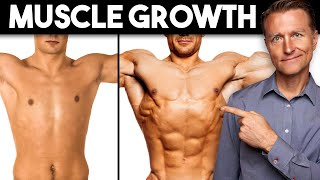
Introduction: How to speed up muscle growth
Let's talk about the four ways to speed up the growth of muscle. Now, you have about 650 muscles in your body, and I'm talking mainly about the skeletal muscles, not the other muscles. The purpose of muscle is to create movement, to help you with posture, and to help you even with your metabolism. If you don't have enough muscle mass, let's say you're getting older and you lose your muscle, you lose your metabolism too. You have a lot of mitochondria that help you burn fat in your muscle, and muscle also helps pump the lymphatic system. So if you don't move a lot, you're not going to pump your lymph through your body.
Now, there are two not-surprising ways to increase muscle growth that you already know: high-intensity exercise and the consumption of protein. You're not going to grow muscles on a vegan burger, okay, or a plant-based burger. It's not going to happen. You need the best source of protein, and that would be animal protein. Steak and eggs are at the top of the list.
How much protein is needed to build muscle?
Now, how much protein do you need? Anywhere between 0.8 to 1.5 grams of protein per kilogram of weight. What I mean by kilogram of weight is kilogram of your lean body muscle weight. So if you're a really big person and you have a lot of fat, you've got to do this calculation on your lean body mass, and I will put a link down below to help you figure out that calculation. If you're not into kilograms and you're into pounds, there's a different formula for that, and I'm going to put that down below too.
When you're talking about grams of protein, we're not talking about the actual weight of a steak, for example. We're talking about the protein in that steak. Let's say, for example, if we talk about pounds, and you weigh about 185 pounds, and that's how much lean body mass you have, that would come out to about 84 kg. If we do the calculation on 0.8 g, I would just multiply 84 by 0.8, and that comes out to 67 g. Then if we look at the high range, 1.5 g, and do that calculation, we're talking between 67 g of protein to 126 g of protein.
So what would determine if you're on the low end or the high end? Your age, how active you are, how much exercise you do, and the strength of your digestive system. Like, if you're 95 years old, you're probably not going to do the top highest amount of protein, versus if you were an athlete at 20 years old. Some people might even need to go up to 2 grams of protein per kilogram of lean body mass.
Four ways to speed up muscle growth
Now let's get into the surprising things that can increase the speed of muscle growth. The first thing on the list is creatine. By the way, creatine is in foods, especially meat, but if we want to speed up the growth of muscle, we want to take it as a supplement. It's not necessarily creating muscle itself, but indirectly it is, because creatine is kind of like a buffer or a substitute for energy, especially for the initial high-intensity exercise of short duration, even before glucose is made. You use a type of creatine, and that's used as energy to allow you to recycle or recover this ATP. What's unique about that is when you exercise at high intensity for a short duration, that is what increases muscle growth, and creatine allows you to do that. If you don't have enough creatine, you're not going to have the energy to work out like that. Number one, and the energy that's supplying the system can actually help you grow this muscle. It allows you to do more work. If you're going to go work out and build muscles and you're tired and you don't have enough energy, it's probably not going to happen.
As far as how much creatine you need, if you're really serious about building muscles, I would use 20 g for about 5 days, and then go down to a maintenance dosage of 3 grams for the rest of the month. Then you would cycle to a higher amount, 20 grams for 5 days, and then cycle back to your smaller maintenance amount.
Number two is cold therapy. You can do cold showers, cold immersion, cryotherapy. There are a lot of different versions of this. When you're in the cold, the body has to do something very unique: it has to maintain the core temperature, so it has to generate a tremendous amount of energy to do that. To do that, you're going to generate this type of brown fat, which then stimulates the white fat, and you're going to burn a lot of calories. The combination of burning more calories, burning more fat, and cold therapy, both in rats and humans, increases the expression of the muscle gene, certain genes in your muscles that help the growth of muscle, as well as something called the RNA, which is kind of like the protein factory that makes different proteins. Cold therapy increases that. Cold therapy also decreases inflammation. You may have heard of studies that show that cold therapy actually does not increase your muscle, and it actually will shrink your muscles. That is true initially, but in the recovery phase it will increase muscle size. It's kind of like any type of stress: you can overdo it. We want intermittent stress to the body to create some cool changes.
Number three is intermittent fasting. There's one school of thought that if you're not eating, your muscles are going to waste away. But what happens when you do intermittent fasting? You stimulate growth hormone, and you stimulate all sorts of things that can indirectly increase muscle through the hormone growth hormone. Here's the catch-22: you're probably not going to grow any muscles if you're doing any type of prolonged fasting. I'm talking about just doing intermittent fasting, like two meals a day, not cutting your calories down, just not having the snacks, because intermittent fasting will also make insulin more sensitive. By fixing insulin resistance, you can actually get more insulin to the muscle, because snacking just kills this whole process. Here's another catch-22: you've got to be somewhat healthy to do fasting. If you take a really sick person and start to put them on the stress of fasting, it might not be the best thing to start them out on. I'm talking about a person who is not sickly, who has somewhat good health, and who can do this correctly and also combine it with exercise at the same time, because they have the energy to do it.
Number four is arginine. It can significantly help you increase growth hormone by inhibiting another hormone called somatostatin. Arginine kind of takes the brakes off growth hormone. They've even given children who are a bit shorter than they should be about 2.2 g of arginine, and they actually grew taller. Arginine is another surprising way to enhance the growth of muscle. What you want to do is take a higher amount, between 3 to 6 g per day, on an empty stomach. I think the best time to take it is about 30 minutes before you work out.
Watch my other videos for more muscle-building tips!
If you have not seen my other powerful video on how to grow muscles, I put it right here. Check it out.