 digest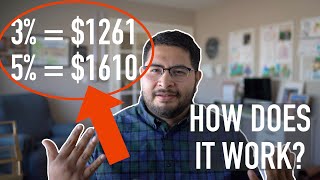
Hello everyone and welcome to another real estate video. My name is Xavier Edina, the real estate YouTube guy here in Phoenix, Arizona, helping you accomplish your home goals. Right now a common thing being pushed is that regardless of what's going on, the good thing about buying a house right now is that you're getting a low interest rate. I've sold houses for a while, and especially with first-time homebuyers I've seen all kinds of interest rates, but I've never actually broken down and boiled down the actual benefits of a lower interest rate. When we look at interest rates, normally they're cute: 3%, 4%, 5%. It seems like a little chump change that your grandma would give you to go get some ice cream from the ice cream man, or, at least in my hood, the corn man. But anyways, I want to actually break down the real benefits of having a lower interest rate and talk about what seems like a very complicated subject, boil it down, and see what it really means for not only your monthly payment but over the life of the loan.
In this scenario I'm going to use an example with a $300,000 loan amount. There's a difference between the loan amount you take on a house versus the actual price you pay for it. For example, if I buy a house for $320,000 and I put $20,000 down, my loan amount is $300,000. So in this example I will use $300,000. It's just an easy number to use, and it can be less or more depending on your state. California people already type in the comments how cute it was that I used 300,000.
First, let's break down what the actual interest rate does for your monthly payment, or for your loan. Using this example, where we have a $300,000 loan and a 4% interest rate, here's what happens. On your first payment ever, your loan amount is $300,000. They calculate the percentage rate and multiply it by your loan amount. So if you have $300,000 and multiply by 4 percent, you get $12,000. Every month they take one month's worth of that annual interest amount: $12,000 divided by 12 gives $1,000. So the first month you make a house payment, they're collecting a thousand dollars of interest.
What's tricky here is that there's always an amount being applied toward principal. In this case, using 4%, the amount applied toward principal in this scenario is $432. So $1,000 is paid toward interest and $432 is paid toward principal, meaning your loan balance only goes down $432. Your new balance is $299,568. For the next month, they use the new balance to figure out your annual interest amount, divide that by twelve, and get a number that you'll see hasn't really changed much. So it's slowly starting to get lower every month you pay. What's interesting is that the interest and principal amounts from the first payment always add up to the same number. As your interest portion slowly goes down, your principal portion increases very slightly, but the total always stays the same. Even the last payment you make, thirty years later, will be five dollars for interest and one thousand four hundred twenty-seven dollars toward principal, and regardless of the month, it always adds up to the same total payment. Why is it that amount? I don't know. I'm sure someone with a bigger brain can figure that out.
Now that you know how it works, I'd like to break down three examples. We're still using $300,000 as the loan amount, but I'll compare a 3% interest rate, a 4% interest rate, and a 5% interest rate. Each of these scenarios always adds up to one thing: you're going to pay back the $300,000 you originally borrowed. That never changes, because you borrowed $300,000. But what is that one point of interest really costing you? At a 5% interest rate, once it's said and done, after living in the house for thirty years, you would have paid over two hundred seventy-nine thousand seven hundred sixty-seven dollars in interest, meaning you paid a total of five hundred seventy-nine thousand seven hundred sixty-seven. That's right, it's almost double. I thought we were talking five percent, not fifty percent. Well, five is what it is. I was working with the numbers for a bit, and I wanted to find out what interest rate would actually make me pay double the amount I borrowed in interest. I found that 5.31% is the number that would literally make me pay three hundred thousand dollars in interest, actually three hundred thousand four hundred, and six hundred thousand four hundred in total. So we're talking about 5%, and we're talking about close to double. As you can see, the monthly payment is about sixteen hundred and ten dollars. That's just principal and interest; it doesn't include taxes, insurance, and whatnot.
When looking at 4% interest, here's what we find. The monthly payment goes down to fourteen hundred thirty-two dollars, which is not bad: that's about a hundred seventy-eight dollars less per month, almost two hundred dollars, which isn't too bad. But you'll notice the total interest goes down dramatically. If the math is correct, you're paying sixty-four thousand dollars less just for that one point of interest. If you live in this house for thirty years, sixty-four thousand dollars is a lot of money. Last but not least, at 3%, the monthly payment goes down to one thousand two hundred sixty-four dollars and eighty-one cents, and the total interest goes down to one hundred fifty-five thousand three hundred thirty-two dollars. That's about sixty thousand dollars less in total interest paid and a little under two hundred dollars less per month. We're looking at a difference of about a hundred twenty thousand dollars total over the life of the loan, paid to the lender, just for those two points of interest. This is especially true with down payment assistance, where we usually see it being one or maybe two points higher.
I know we're a bunch of young cuties here and we don't like to think about the future, especially thirty years from now. You might think, "Well, I'm going to sell the house anyway." But let's say you do stay in your house for thirty years. Do you think one hundred twenty thousand dollars would make a difference in your bank account? That's the number one change I see. Well, actually, it's number one and number two, but let's say number one: you're going to pay a lot more in total over thirty years. You're paying probably about $60,000 more over the life of the loan with just one point of interest. The second thing I was talking about is the monthly payment going down, maybe about two to three hundred dollars depending on the situation, and in this scenario it's almost two hundred bucks.
The second thing I got curious about was how my payment splits between interest and principal. Initially, when I was looking at the 5% number, I found two things to be true: the amount you pay per month and per year is always the same. For our $300,000 loan at 5%, every single month adds up to sixteen hundred and ten dollars, and every year will look the same regardless of whether it's the first year or the thirtieth. The only thing that changes is the split between interest and principal. So I was curious to see what that split looks like at 5% and the difference compared to 3%. At 5%, in year one, looking at yearly rather than monthly figures, seventy-seven percent of the total amount we paid that year goes toward interest. That's almost eighty percent of what you paid toward your mortgage going purely to interest, which is pretty depressing, because you're paying a lot of money and having to charge the interest sucks. But I was curious whether that percentage changes with a lower interest rate.
At 4%, I noticed two changes. First, your monthly amount, which never changes, goes down. Instead of sixteen hundred ten dollars and forty-six cents, I'm paying fourteen hundred thirty-two dollars and twenty-five cents, and that number never changes. Because of that, my annual number changes as well, so I have to come up with less monthly and less annually. Looking at the ratio in year one compared to 5%, which was 77% interest and 22% principal, notice the difference: in year one at 4%, I paid 69% toward interest and 31% toward principal. So almost 10% more of my payment goes toward principal. Not only am I paying less interest, I'm paying more toward principal from the start. It's worth noting that in both of these situations, as you live in the house, the split starts to shift very slightly, usually by about one or two percent each year. For example, the 4% split goes from 69/31 in year one, to 68% in year two, 66% in year three, and it slowly keeps going down about 1 to 2% on average.
Hey guys, my camera died on me for a bit and I had to charge it and put it back on, so I'm sorry if the position or lighting is different. But if we finish by looking at our golden boy, 3%, we notice that the monthly amount you owe is going to be a lot less, clearly $1,200, and the annual amount is therefore a lot less as well. We know that lower interest means you're paying less. What's really surprising is that the ratio going toward interest versus principal in year one is about 10% less than at 4%. So you're starting off paying 59% of your total monthly payment toward interest and 41% toward principal. I don't know about you, but to me, when I make my monthly payment, it's nice knowing that 80% of it isn't going toward interest, which is basically money the lender is making on the loan, passed along to their investors or whatever the situation is.
So guys, credit score matters. If you're looking to buy in six months, a year, or two years, and right now you're having a hard time with what's going on in this world, I'm so sorry for what's going on, but make sure to try to get your credit as high as possible. Don't let that go to waste. I've seen people say, "I'm just going to pay 30 days late, whatever." No. Do your best to make payments as you can. Don't let it go to waste, because that decision to maybe not make your payment one month will affect you two to three years from now when you want to buy your house. You're going to say, "Oh, I'll just get a percent of interest more." No, you're not getting a percent of interest more. You're paying $60,000 more over the life of the loan, paying more toward interest initially when you start your loan, and you'll have a higher monthly payment. Don't do that to yourself. Just do what you can to save.
Anyways, guys, that's all the time we have today. Thank you so much for watching. I really appreciate your time. I know this was a complicated subject and I'm sure I missed a lot of it, but even what I explained might have been complicated, so if you have any questions, please leave them below. If you are in the Phoenix, Arizona area and you want a realtor to help you, remember I am not taking in-person appointments right now. I am meeting people through Zoom, so please schedule your appointment or reach out to me, and we can schedule something and get face-to-face going. For everyone else across the country who wants my help with something, I'm still working on the workbook, which is basically a purchasable ebook that you can fill out with your partner or by yourself to get your home goals started and get educated on the home buying process. I'm also going to offer an alternative option for anyone who wants me to consult with them and go over the worksheet together and get them prepared, whether it's next month or a year from now. I will have those options available soon. If you want to be notified when this is available, either follow me on Instagram or, if you've downloaded any of my free printables, you'll get emailed when it's time. Thank you guys so much. I appreciate your time and have a wonderful day.