 digest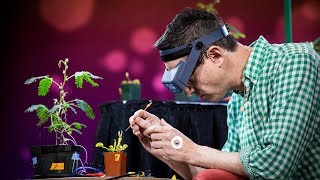
I'm a neuroscientist and I'm the co-founder of Backyard Brains, and our mission is to train the next generation of neuroscientists by taking graduate-level neuroscience research equipment and making it available for kids in middle schools and high schools. When we go into the classroom, one way to get them thinking about the brain, which is very complex, is to ask them a very simple question about neuroscience, and that is: what has a brain? Students will instantly tell you that their cat or dog has a brain, and most will say that a mouse or even a small insect has a brain, but almost nobody says that a plant or a tree or shrub has a brain. This could actually help describe how the brain functions. You push and say, well, what is it that makes living things have brains versus not? Often they'll come back with the classification that things that move tend to have brains, and that's absolutely correct. Our nervous system evolved because it is electrical; it's fast, so we can quickly respond to stimuli in the world and move if we need to. But you can push back on the students and say, you say that plants don't have brains, but plants do move. Anyone who's grown a plant has noticed that the plant will move and face the Sun. They'll say, but that's a slow movement, that doesn't count, that could be a chemical process. But what about fast-moving plants?
In 1760, Arthur Dobbs, the royal governor of North Carolina, made a pretty fascinating discovery in the swamps behind his house. He found a plant that would spring shut every time a bug would fall in between it, and he called this plant the flytrap. Within a decade it made its way over to Europe, where eventually the great Charles Darwin got to study the plant, and it absolutely blew him away. He called it the most wonderful plant in the world. This is a plant that was an evolutionary wonder: a plant that moves quickly, which is rare, and that is carnivorous, which is also rare. It's in the same plant. But I'm here today to tell you that's not even the coolest thing about this plant. The coolest thing is that the plant can count.
In order to show that, we have to get some vocabulary out of the way. I'm going to do what we do in the classroom with students: we're going to do a lexicon on electrophysiology, which is the recording of the body's electrical signals, either coming from neurons or from muscles. I'm going to put some electrodes here on my wrists, and as I hook them up we're going to be able to see a signal on the screen. This signal may be familiar to you; it is called the EKG, or electrocardiogram, and it is coming from neurons in my heart that are firing what's called action potentials. Potential means voltage, and action means it moves quickly up and down, which causes my heart to fire, and that causes the signal you see here. I want you to remember the shape of what we're looking at right here, because this is going to be important. This is a way that the brain encodes information in the form of an action potential.
Now let's turn to some plants. I'm first going to introduce you to the mimosa, not the drink, but the Mimosa pudica. This is a plant found in Central America and South America, and it has behaviors. The first behavior I'm going to show you: if I touch the leaves here, you'll see that the leaves tend to curl up. The second behavior: if I tap the leaf, the entire branch seems to fall down. Why does it do that? It's not really known to science. One of the reasons could be that it scares away insects, or it looks less appealing to herbivores. But how does it do that? That's interesting, and we can do an experiment to find out. Just like I recorded the electrical potential from my body, we're going to record the electrical potential from this plant, this mimosa. I've got a wire wrapped around the stem, and I've got the ground electrode in the ground. So I'm going to go ahead and tap the leaf here, and I want you to look at the electrical recording we're going to see inside the plant. What is that? That is an action potential happening inside the plant. Why was it happening? Because it wanted to move. When I hit the touch receptors, it set a voltage all the way down to the end of the stem, which caused it to move. In our arms, we would move our muscles, but the plant doesn't have muscles. What it has is water inside the cells, and with a voltage hit, it opens up, releases the water, changes the shape of the cells, and the leaf falls. So here we see an action potential encoding information to move. But can it do more? Let's find out.
We're going to go to our good friend, the Venus flytrap, and take a look at what happens inside the leaf when a fly lands on it. I'm going to pretend to be a fly right now. Inside the leaf, you'll notice there are three little hairs, and those are trigger hairs. When a fly lands, I'm going to touch one of the hairs. Ready? One, two, three. What do we get? We get a beautiful action potential. However, the flytrap doesn't close, and to understand why, we need to know a little more about the behavior of the flytrap. Number one, it takes a long time to open the traps back up, about 24 to 48 hours if there's no fly inside, so it takes a lot of energy. Number two, it doesn't need to eat that many flies throughout the year; it only needs a handful. It gets most of its energy from the Sun; it's just trying to replace some nutrients in the ground with the flies. The third thing is it only opens and closes the traps a handful of times before that trap dies, so it wants to make really darn sure there's a meal inside before the trap snaps shut. So how does it do that? It's the number of seconds between successive touches of those hairs. The idea is that there's a high probability that if there's a fly inside, the touches are going to be quick together. So when it gets the first action potential, it starts counting: one, two, and if it gets to 20 and doesn't fire again, it is not going to close. But if it fires again within that window, the flytrap will close. I'm going to touch the Venus flytrap again. I've been talking for more than when I touch the hair a second time, so what do we get? We get a second action potential, but again the leaf doesn't close. Now if I go back in there, and I find my fly moving around, I'm going to be touching the leaf a few times. I'm going to brush it a few times, and immediately the flytrap closes. Here we're seeing the flytrap actually doing a computation: it's determining if there's a fly inside the trap, and then it closes.
So let's go back to our original question: do plants have brains? The answer is no. There's no brain in here, no axons, no neurons. It doesn't get depressed, it doesn't want to know what the Tiger score is, and it doesn't have self-actualization problems. But what it does have is something very similar to us, which is the ability to communicate using electricity. It uses slightly different ions than we do, but it's doing the same thing. To show you the ubiquitous nature of these action potentials: we saw it in the Venus flytrap, we've seen an action potential in the mimosa, and we've even seen an action potential in a human. This is the language of the brain; it's the way that all information is passed. So we can use those action potentials to pass information between species of plants. This is our interspecies plant-to-plant communicator. We've created a brand new experiment where we record the action potential from a Venus flytrap and send it into the sensitive mimosa. Recall what happens when we touch the leaves of the mimosa: it has touch receptors that send that information back down in the form of an action potential. So what would happen if we took the action potential from the Venus flytrap and sent it into the stems of the mimosa? We should be able to create the behavior of the mimosa without actually touching it ourselves. If you allow me, I'm going to go ahead and trigger this now by touching the hairs of the Venus flytrap. So we're going to send information about touch from one plant to another. There you see it.
I hope you learned a little something about plants today, and not only that, you learned that plants can be used to help teach neuroscience and bring along the neuro revolution. Thank you.