 digest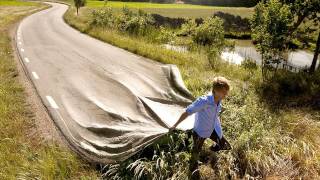
So, I'm here to share my photography. Or is it photography? Because of course, this is a photograph that you can't take with your camera. Yet my interest in photography started as I got my first digital camera at the age of 15. It mixed with my earlier passion for drawing. But it was a bit different because using the camera, the process was in the planning instead. And when you take a photograph with a camera, the process ends when you press the trigger. So to me, it felt like photography was more about being at the right place at the right time. I felt like anyone could do that. So I wanted to create something different, something where the process starts when you press the trigger.
Photos like this show construction going on along a busy road, but it has an unexpected twist. Despite that, it retains a level of realism, or photos like these, both dark and colorful, but all with a common goal of retaining the level of realism. When I say realism, I mean photo realism, because of course it's not something you can really capture, but I always wanted it to look like it could have been captured somehow as a photograph. These are photos where you will need a brief moment to think to figure out the trick. So it's more about capturing an idea than about capturing a moment, really.
But what's the trick that makes it look realistic? Is it something about the details or the colors? Is it something about the light? What creates the illusion? Sometimes the perspective is the illusion, but in the end it comes down to how we interpret the world and how it can be realized on a two-dimensional surface. It's not really about what is realistic; it's about what we think looks realistic. So I think the basics are quite simple. I just see it as a puzzle of reality, where you can take different pieces of reality and put them together to create an alternate reality. Let me show you a simple example. Here we have three perfectly imaginable physical objects, something we all can relate to, living in a three-dimensional world, but combined in a certain way, they can create something that still looks three-dimensional, like it could exist, but at the same time, we know it can't. We trick our brains because our brain simply doesn't accept the fact that it doesn't really make sense. I see the same process with combining photographs. It's really about combining different realities.
So the things that make a photograph look realistic, I think, are the things we don't even think about, the things all around us in our daily lives. But when combining photographs, this is really important to consider, because otherwise it just looks wrong somehow. I would like to say that there are three simple rules to follow to achieve a realistic result. As you can see, these images aren't really special, but combined they can create something like this. The first rule is that photos combined should have the same perspective. Second, photos combined should have the same type of light. These two images both fulfill these two requirements: they were shot at the same height and in the same type of light. The third rule is about making it impossible to distinguish where the different images begin and end, making it seamless, so it's impossible to say how the image was actually composed. By matching color, contrast, and brightness in the borders between the different images, and adding photographic defects like depth of field, desaturated colors, and noise, you erase the borders between the different images and make it look like one single image, despite the fact that it can contain hundreds of layers.
Here's another example. One might think this is just an image of a landscape and the lower part is what's manipulated, but this image is actually entirely composed of photographs from different locations. I personally think it's easier to actually create a place than to find a place, because then you don't need to compromise with the ideas in your head. But it does require a lot of planning. Getting this idea during winter, I knew I had several months to plan it and to find the different locations for the pieces of the puzzle. For example, the fish was captured on a fishing trip. The shores are from a different location. The underwater part was captured in a stone pit. And I even turned the house on top of the island red to make it look more Swedish. So to achieve a realistic result, I think it comes down to planning. It always starts with a sketch, an idea. Then it's about combining the different photographs, and here every piece is very well planned. If you do a good job capturing the photos, the result can be quite beautiful and also quite realistic. All the tools are out there, and the only thing that limits us is our imagination. Thank you.