 digest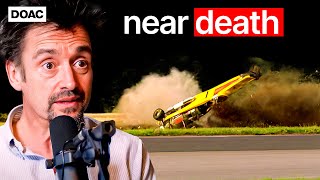
I was aware something had happened, but all I recall is a sense of "oh no," because I was just decelerating upside down, using my head as a brake. It isn't good for you. There was genuinely no fear associated with it. It was answering a question that had kind of been at the back of my mind, and I think a lot of us always wonder about it: when am I going to die, and how, and why. It was like, "Oh, it's now. That's the answer. That's the next thing to do." That was it. Then I wasn't conscious again until later. I was conscious apparently when they got to the car, but I have no recollection because the damage was done: brain deceleration, sloshing forwards, a frontal lobe bleed. Just decelerating upside down using my head as a brake, it isn't good for you.
You talked about a crash earlier while you were filming Top Gear. Yes, I'm not a very good driver. I was 36 years old, 2006 I believe. Take me to that day. Well, we'd had a discussion in the office, and I have told this story before, so some people might be bored of it, sorry. Andy Willman, the editor, had said he got this chance for this car to be driven, and I'd gone into the office saying, "Look, I just want to go really fast. What's the fastest we can go?" It was that dumb an idea. They came up with this car, and I went to drive it and turned up on the day. I did numerous runs in the thing. It was pretty basic and crude, really quite fast, especially when you hit the afterburner, a jet-propelled dragster. I didn't have a speedo in the car, because I knew I'd be chasing speeds and that would be dangerous, so there was no speedo. I didn't know how fast I was going until after the event. You stopped it from high speed by pulling the parachute cord, and the parachute came out and stopped it. I'd done all the day's runs, and the director came over and said, "Rich, we've got permission for one last run." We were happy with how it had gone, but let's get one more bag of shots.
The car had what happened: the front tyre delaminated and blew. The car had skewed right and was going off the road, but it was still doing 290 miles an hour as it started to roll. I'd pulled the lever for the parachute, which was all that mattered to me. When I finally, weeks or months later, became aware of what was happening, I needed to know whether I had done that, because I looked at my children and thought, if I've nearly denied you a father for the rest of your lives because I'm an idiot and did the wrong thing, I wouldn't forgive myself. But I did do the right thing. It was never going to stop anyway. So then it went over and rolled, and as it went over I knew there was no roof, just a roll bar. I didn't know how fast I was going, but I knew it was fast, and I just thought, well, I'm going to die now. But it wasn't. I'm on record as saying this and I don't want to go on about it, because I get self-conscious and don't want anybody to think, "Oh, stop going on about that." But if you are interested, I found it interesting that there was no fear associated with it.
While you were unconscious in hospital, what was going on in your family at that time? Mindy, my wife, was called. She was on the road. She was called by Wellman, and they all spoke. It was hard. My daughters were young, and for them to grasp it was pretty difficult. It's disruptive, it's horrible, and it's hard. My memories are all over the place anyway, because I had very bad post-traumatic amnesia for weeks, like a one-minute memory. My wife always says I was the nicest I've ever been. I was lovely, perfectly happy, which has made me think often since that you've got a friend, or we all have friends or ourselves whose parents are going through whatever degenerative form of illness, losing memories. I always say to him, "Is she happy?" "Yes, fine." "If I go to see them, will you come into the pub to see me three or four times?" "Yes," and she is equally happy each time. That's all right, it doesn't matter. I was perfectly happy reading the same newspaper every single day, several times a day. It was by my bed. I'd just pick it up and go, "Oh brilliant," then read it, put it down, and a minute later it was gone, until Mindy took it away because she was sick of seeing me read it. It was more distressing for others than for me, and the message there is: if somebody is in that confused state, of whatever variety, and for whatever reason they're happy, then all you've got to do is cope and support them in their happiness. It doesn't matter if they can't remember who you are or what anything is. If they're happy, they're happy, and that's that.
When you were in that coma, I watched the video you produced about your morphine dream, the incredibly powerful video about the crooked tree on the hill. Is that true? Was there morphine? I was in a coma, as they held me in a coma because my brain was expanding post-crash. They were holding me in coma, but it was looking very, very bad, and they had called Mindy in. They said, "I think we're losing him." She said, "Is there anything I can do?" They said, "Not really, try anything." So she roared and shouted at me, "Don't you dare!" I'm quite sweary and cross, and she was cross. She didn't want me to die. I think lots of people have done that, and I think I'd do that too, when all else has been tried and failed and somebody is lying there. It's a last resort: "Don't you dare, because I want you around." It's not just a movie trope. You are calling to somebody, and I think we know in our hearts that we do have a great deal of independence in terms of what happens to us. Our mind is a powerful thing. Mind and body are one. A chiropractic friend of mine, an osteopath friend of mine, Steve, obviously a very well-read man, and we were talking about mind and body as one, about bringing mind and body to work together, and he said, "Well, yes, it is all one, because they've never been apart." Your body and mind have never existed separately. They've only ever existed as one, and one needs the other and complements the other. That's why, in that coma state, which is only an altered state of consciousness and I'm not dead, I picked up on the emotion from Mindy, the anger. I thought, "Oh, I'm in trouble now." It's not funny anymore. It's a very distinctive flavour, when you're being a bit naughty and cheeky, and then you realise, oh no, I really am in trouble. That's when she was really roaring. Her mind can do an awful lot with our bodies. There's enough evidence of that.
Your mind took you to your favourite place, which gives me immense comfort, because it will do that eventually anyway. I know that's where I'll go. Given that at the moment of dying the body shuts down and stops doing all the things it does, you're no longer tired by all of those, by time, by biological rhythms, by lunar rhythms. None of those matter, and you're no longer beholden to them, which is a kind of eternity. So if my last thought is of walking around that tree, I was up there two weeks ago, district, yes, I went to the same tree. My mind takes me around there, and that thought echoes a form of eternity as far as I'm concerned. The universe only exists as far as I'm concerned, or as you're concerned; it's only your perception of it. If that last moment is no longer constrained by worrying about heartbeats or the cycling of the seasons, it's kind of an eternity, isn't it? I wouldn't mind hanging around by that tree forever.
What was happening in that dream? You were in a coma and had a sort of morphine-induced dream while you were walking up a hill? Yes, I was walking up the hill towards a tree, and I was growing crazily conscious that I was going to be in trouble for carrying on. "No, I'm going to carry on, I just want to press on." Then, as I reached the tree, it was very clear: "Oh no, I really am going to be in trouble. I'd better go back." That's the point. I just related that story as a unit to Mindy. It was very clear when I was brought out of the coma shortly after, and that's when it happened. It could be a story. Don't forget, your brain fills in things after the fact. A sense of recollection is all you need for something to be in the past. It doesn't actually have to be in the past, but I've retained immense comfort from it. I find it very comforting and warming to think so, so I'll continue to think it.
If you love the Diary of a CEO brand and you watch this channel, please do me a huge favour and become part of the 15% of viewers on this channel who have hit the Subscribe button. It helps us tremendously, and the bigger the channel gets, the bigger the guests. Thank you.