 digest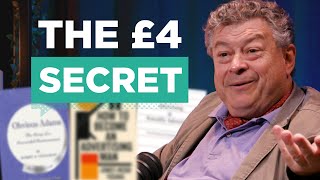
The value of Obvious Adams
Read a book. Everybody read a book. You can buy it for four quid. It was written in 1916 by a guy called Robert Updegraff. It's called Obvious Adams. It was one of David Ogilvy's favorite books. And if you read nothing else as a business book, it's literally 60 pages. You will start reading the first two or three pages and you'll think, why has Rory recommended this hokey book? By page eight, you'll go, this is better than the Harvard Business Review.
It's a book featuring an advertising guy, but it doesn't have to be an advertising guy. He's really a marketing problem solver who achieves his amazing success by noticing things that are too obvious for other people to talk about. I think that book is an absolute prize. Amusingly, which really delights me, is every now and then I plug it on a podcast and I go onto Amazon and Obvious Adams is number three in advertising or marketing on Amazon. It fills me with joy to think that this book written in 1916 is still being bought. It deserves to be bought because, like Ogilvy on Advertising or Claude Hopkins, all of those old advertising books are still worth reading. James Webb Young and all of those authors were going far enough up to uncover truths that are really universal human truths about how we react to communication, not fanciful tech models of how humans should decide and act.
Marketing to non-marketers
We think about the traditional current-day marketer and we're thinking about this kind of unpredictable world. There are probably a few different poster boys. I'm just a man. Look, seriously, there's a lot of people who know this stuff. What I don't understand is why the advertising and marketing world failed to notice that they are much more interesting to people who aren't in marketing and advertising than the people inside those worlds actually notice.
Rethinking business metrics
All I'm trying to do is get some of this information to enter the conversation. I'm not claiming to be right about anything. This is why I'm dissing the scientific method, because it's all about being inarguably right rather than solving a problem. I'm dissing the misapplication of what is pseudoscience. In other words, something that has the appearance of being scientific and logical which actually is a gross misdirection of effort, or at least only works over the shorter term before it starts being gamed or creating distortions.
Psychological problem solving
One of the things entrepreneurs do is they wait for big companies to get trapped by their own metrics. The pursuit of those same metrics then effectively drives them into a corner which leaves a market space available for somebody else. All I want people to do is to go, every time I've got a problem, there may be a psychological solution to it. Maybe the problem is perceptual; it's to do with people's own epistemology. Maybe the solution is a creative thing. Maybe the problem is a trivial thing because psychology doesn't have a sense of proportion. It's a bit like poker, in that in poker you have a thing called a "tell," which is usually a very small thing that the signaler is unaware of but which the other poker player spots.
The importance of fame
If we demand this ludicrous burden of proof that you can only actually try something if you can already prove it works, we're basically turning our back on any business that has decided it would rather be certain than get lucky. I'll give you an example of this. One really valuable but almost impossible to predict and evaluate quality of a business is just being really famous. People can't buy something if they don't know it exists, and they're less likely to buy something if they've never heard of it before. But also, if you're indiscriminately famous, you discover who your target audience really is, rather than being focused on those people who your algorithm tells you it is. If you get more and more focused on marketing efficiency, you get trapped in a local maximum. You never discover new markets.