digest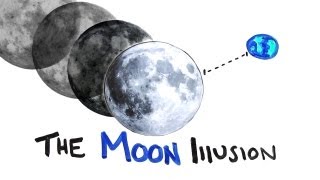
Short Summary
Main recommendation: Don't trust your eyes about the size of the Moon near the horizon; it is the same physical size as when it is high in the sky, and the apparent enlargement is the Moon Illusion, a perceptual effect. The video explains that the Moon looks bigger near the horizon because the brain compares it to nearby objects and compensates for perspective, though the exact explanation is still debated.
Key Points
- The Moon's angular size does not actually change between the horizon and high in the sky; measuring it shows the same size.
- The main theory: near the horizon, trees, buildings, and mountains give the brain reference points, making the Moon seem larger, while high in the sky there is nothing to compare against, so it seems smaller.
- The Ebbinghaus illusion is offered as a similar effect: two identical orange circles look different in size depending on the size of the circles surrounding them.
- The brain compensates for perspective: distant objects near the horizon, like clouds, normally look smaller, so the brain assumes the horizon Moon must be physically larger.
Details Worth Noting
- Concrete instructions:
- Test it with your thumbnail: hold your thumbnail at arm's length and compare it to the Moon when it is near the horizon and again when it is high in the sky. The Moon should not change size against your thumbnail.
- Bend over and look through your legs at the horizon Moon; the illusion is reduced because upside-down trees and buildings no longer register as familiar objects and depth perception is not confounded.
- If you can't bend over, take a photo of the Moon near the horizon and one high in the sky; the camera will not suffer the illusion and will show the Moon is the same size.
- The video says the explanation of the Moon Illusion is still debated, so the perspective and reference-point theories are the main accepted ideas, not settled fact.
- The Ebbinghaus illusion example uses orange circles surrounded either by smaller or larger circles to show how context alters perceived size.
Bottom Line
The Moon looks bigger near the horizon because of how your brain interprets context and perspective, not because it is physically closer or larger.