digest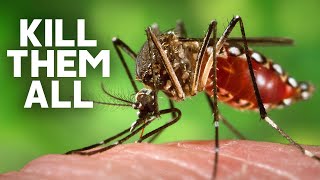
Short Summary
Main recommendation: Instead of killing every mosquito, release Wolbachia-infected mosquitoes into the wild so they spread the bacterium through the population and block dengue transmission. The video says this approach cut dengue sharply in trial regions, including a reported 95 to 97% decline in the Aburrá Valley, Colombia. It frames this as a targeted alternative to eradication, which the video suggests would be neither feasible nor clearly harmless.
Key Points
- The video cites a Nature journal analysis finding little fallout for humans if mosquitoes disappeared, since few species depend heavily on them and most of the roughly 3,200 species do not bite humans.
- Only about 200 of those species bite humans, yet mosquito-borne diseases still infect around 247 million people with malaria each year, along with dengue and Zika.
- Wolbachia, a bacterium present naturally in about 50% of insects, appears to outcompete viruses such as dengue, yellow fever, and chikungunya inside mosquitoes, preventing them from spreading to humans.
- Wolbachia spreads through a population because infected females pass it to their eggs, and mosquitoes released over a few months can establish it across wild populations.
- Deployments in 14 countries reported dengue reductions; one Indonesian study found 77.1% protective efficacy, with some sites as low as 38%.
Details Worth Noting
- Concrete instructions: The video gives no step-by-step protocol for individuals. The actionable method it describes is for program operators: release Wolbachia-infected mosquitoes into an area, typically for two to six months, so they mate with wild mosquitoes and pass the bacterium on. Mating outcomes are as follows: an infected male with a non-infected female produces eggs that do not hatch; an infected female produces infected offspring whether or not the male is infected.
- The Colombia results came from releases beginning in 2015, with results released in November 2023; the rest of the Americas had its second-worst dengue year since 1980 in the same period.
- Brazil's planned facility is described as able to produce up to 100 million mosquitoes a week for deployment across multiple Brazilian cities, per the scientist interviewed.
- The video states there is no link between Wolbachia and negative outcomes in humans that researchers have found, and that the WHO is evaluating the technology for use in other countries.
- Scientists describe this as a supplementary measure, not meant to prevent or discourage dengue vaccines in high-risk regions.
Bottom Line
Targeted bacterial release is presented as a practical, lower-risk way to reduce disease-carrying mosquitoes than attempting total eradication, though the video notes results vary by community size and environment.