digest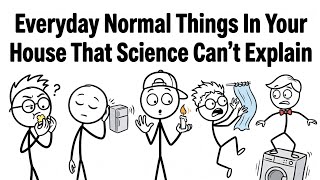
Short Summary
Main recommendation: Treat everyday household oddities as real physics rather than mysteries, since each one (ice cube cracks, faucet warmth, microwave cold spots, soap bubbles, popcorn kernels, fridge hum, candle flicker, shower curtain billowing, washing machine shaking, and a faint "sky hum") has a known or partly understood explanation. The video frames these as things most people notice and never question. It stresses that the physics is settled for some cases but predicting specific outcomes remains difficult.
Key Points
- Ice cubes crack because dissolved gases trapped in tap water expand as the ice warms, and boiling the water first produces clear, crack-free cubes.
- Warm water from the cold tap comes from water sitting in pipes that has warmed to room temperature; the amount and speed depend on home temperature, wall insulation, and outside ground conditions.
- Microwaves form standing waves with a wavelength of about 12.2 cm, creating hot and cold spots; turntables, mode stirrers, and multiple magnetrons help but don't fully eliminate uneven heating.
- Popcorn kernels need a flaw or weak spot in the shell (which the video calls the "paracarp") to burst; without one, steam escapes slowly and the kernel stays unpopped.
- The fridge hum varies because the compressor adjusts its speed to the interior temperature, and the candle flame's flicker and shape depend largely on gravity-driven convection.
- The shower curtain billowing inward is attributed to a combination of the Bernoulli effect, buoyancy from rising warm air, and airflow dragged by falling water droplets, and no single theory fully explains it.
Details Worth Noting
- Concrete instructions: The video gives no step-by-step instructions, recommended settings, amounts, or actions for the viewer to take. Its only actionable-looking content is the observation that boiling tap water before freezing removes dissolved gas so the ice cubes freeze clear and do not crack.
- Microwave standing waves: The video cites a wavelength of about 12.2 cm and notes that engineers use turntables, mode stirers, and multiple magnetrons to reduce hot and cold zones, though physics is not fully beaten.
- Candle flame in space: On the International Space Station, a candle flame burns as a sphere, dimmer, cooler, and blue, because without gravity convection is absent and the flame depends on slower diffusion.
- Popcorn pressure and rate: Kernel steam builds to about nine times atmospheric pressure, and popcorn companies reportedly reach over 90% pop rates with uniform moisture and controlled heating, but 100% is impossible.
- Washing machine resonance: Vibration peaks when spin speed matches the machine's natural frequency, which is why suspension systems are designed to damp it.
- Worldwide hum: The video attributes a possible source to ocean waves against continental shelves, notes it is barely audible, and says it is most noticeable in quiet, low-background-noise settings, especially at night.
Bottom Line
Many ordinary household quirks are governed by real physics such as gas expansion, heat transfer, standing waves, pressure, convection, and resonance, but the video stresses that scientists often can't predict exactly when or where each effect occurs.