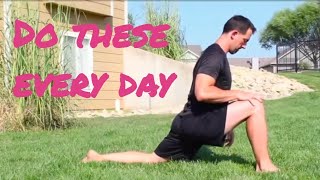
digest
Short Summary
Main recommendation: Do posture exercises such as wall slides, a twisting leg-over stretch, and a daily deep squat, not because posture must be "fixed," but because they strengthen weak muscles, stretch tight ones, and give you more comfortable positional options. The speaker stresses that perfect form is not required and that you should stretch within a comfortable range, avoiding pain.
Key Points
- Standing up straight is neither necessary nor necessarily good; a slight curvature is often more comfortable, so the goal is options rather than a single "correct" posture.
- Posture exercises are worthwhile because they tend to make people feel better and strengthen muscles that are weak while stretching muscles that are tight.
- The speaker's exercises are described as useful even without posture problems, and are chosen for being personally helpful and practical rather than obscure.
- Rotational imbalances often develop because we favor one side of the body, so the twisting stretch targets the tighter side first.
- The wall slide is a stretch where imperfect form is acceptable as long as you feel the stretch and avoid pain.
Details Worth Noting
- Concrete instructions:
- Wall slide: stand with your back as close to a wall as possible, arms raised with the backs of your hands against the wall. Slide up and down while keeping your hands and back in contact with the wall. Tuck in your abs to resist arching your lower back as you go up. An easier variation is to do it with your feet out in front of you or while seated. The twist: when you come back down, squeeze your arms back, hold briefly, and feel it in your back before going up again.
- Leg-over twist stretch: lie down, raise one leg over your body, and turn toward that raised leg. Hold for about 30 seconds to a minute. Stretch the tighter side first, then the other side for the same amount of time. Easier variation: standing, reach behind you to touch a wall and hold, doing both sides.
- Daily deep squat: spend some time every day in your deepest squat. If your heels lift, you can use a tree or similar support to ease down and hold yourself forward. You can move around in the squat, use your arms to assist, and add gentle stretching.
- Form guidance: start with what you can do and improve over time; do not stretch into intense pain and scale back when needed.
- Rounding the back in the deep squat is presented as acceptable and useful, since many daily activities such as working, studying, or reading involve sitting or hunching; the goal is to be strong and mobile in multiple positions.
- The speaker notes the wall slide's name is mostly for memorability, and that the same benefits come from combining wall slides and wall angels.
- Heels lifting in the deep squat is common; the speaker says it is not strictly necessary for posture and may resolve with practice.
Bottom Line
Posture work is about building strength, flexibility, and comfortable options across positions, so begin with simple, forgiving versions of these exercises and progress gradually without chasing perfect form.