digest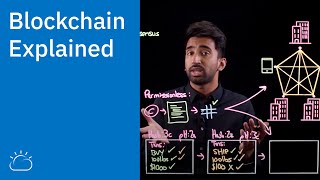
Short Summary
Main recommendation: For business use, consider a permissioned blockchain (such as Hyperledger Fabric) rather than a public, permissionless blockchain like those used for cryptocurrencies, because its trusted nodes allow pluggable consensus and privacy controls, and its smart contracts can automate transactions. The video explains blockchain as a distributed, immutable ledger that tracks almost anything, using the transaction-record, hash-chaining, and consensus concepts that make it tamper-resistant.
Key Points
- A blockchain is a distributed ledger where every node in the network holds a copy of every transaction ever recorded, creating a single source of truth.
- Each block contains its transactions and a hash (a unique digital fingerprint of those transactions) plus the hash of the previous block, so changing any transaction alters its hash and breaks every later link, making tampering apparent.
- Public permissionless blockchains let anyone view transactions and run a node, and they use proof of work, a computationally intensive cryptographic puzzle, to agree on the next block.
- Permissioned blockchains involve known, trusted participants (often whole organizations), so they use pluggable consensus algorithms instead of proof of work and treat privacy as a core requirement.
- Smart contracts are code on the blockchain that executes automatically when defined conditions are met, speeding up processes for all parties.
Details Worth Noting
- Concrete instructions: The video gives no step-by-step setup procedure. Its only actionable guidance is to choose a permissioned blockchain over proof of work when building blockchain for business, to design the network so each party sees only the transactions it is involved in (for example, a retailer seeing its own buy order but not a competing retailer's pricing), and to use smart contracts to automate checks such as confirming order details and warehouse stock before creating a shipment record, with an automatic refund if any condition fails.
- The video's retailer, manufacturer, and shipper example shows how privacy works in practice: the manufacturer sees all the information, while the retailer and shipper each see only what concerns them, such as the retailer's buy order and price but not the shipping cost.
- Proof of work is described as consuming significant processing power and electricity on a global scale, which is why the speaker advises against it for business blockchains.
- The speaker names Hyperledger Fabric as an example of a permissioned blockchain.
- Public cryptocurrency blockchains show addresses rather than real identities, though all transactions remain publicly visible.
Bottom Line
Blockchain's value for organizations depends on the model chosen: permissioned networks trade open participation for efficiency, controlled privacy, and automated smart-contract execution.