digest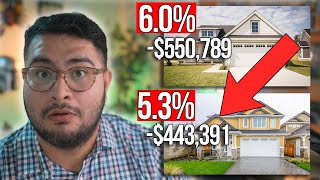
Short Summary
Main recommendation: Pay for an interest rate buy down, which means paying discount points upfront to lower your mortgage rate, and save extra cash (about $5,000 to $10,000) for it before buying a home. The speaker argues the savings over 30 years can be tens of thousands of dollars, and that the break-even point depends on how long you keep the loan.
Key Points
- A discount point costs 1% of the loan amount; on a $300,000 loan, one point is $3,000, and half a point is $1,500.
- Lower advertised rates often require discount points, so ask whether a quoted rate is a true rate or includes discount points.
- Rate reductions are not linear: two points may lower the rate far more than double the effect of one point, as shown in the example.
- Using the speaker's $500,000 example, the client was quoted 6% free, 5.75% for one point, and 5.35% for two points; the two-point option saved about $70,000 in interest over 30 years compared to the free rate.
- The break-even point, when cumulative savings equal the upfront cost, is the key number for deciding whether to buy down.
- Rates fluctuate daily, so the cost of each discount point must be checked at the time of quote.
Details Worth Noting
- Concrete instructions:
- When shopping for a mortgage, ask each lender: "Is this a true rate, or is this with a discount point?"
- Ask for the discount point cost at each available rate, then compare the rate options side by side.
- Calculate the discount point cost by multiplying the loan amount by 1% per point (for a $500,000 loan, one point is $5,000, as shown with the client's actual deal, while the $300,000 example used earlier shows $3,000 per point).
- Use an interest rate buy down calculator or an amortization calculator to see total interest paid over 10, 20, and 30 years for each option.
- Calculate break-even by dividing the upfront point cost by the monthly payment savings to find how many months until the buy down pays for itself.
- Only buy points if you expect to keep the loan longer than the break-even period (the speaker's example: about 5.5 years for one point, about 4.3 years for two points).
- Keep the spare cash for emergencies if the break-even period is long relative to how long you plan to stay.
- In the speaker's $500,000 example (using a 5% rate illustration for the free rate), the monthly payment was about $3,213, and later with one point at 5.75% the payment dropped so that the monthly savings was about $76 compared to the 6% quote.
- The speaker's example shows two points at 5.35% lowering the monthly payment to about $3,018, with about $70,000 less interest over 30 years for an extra $10,000 upfront.
- The speaker notes that a 0.25% difference is not the only factor; the total cost of the loan should also be reviewed using an amortization calculator.
- The speaker presents these examples as personal financial reasoning and not as professional lending advice; consult a licensed lender for your own situation.
Bottom Line
Buying down your rate can save large amounts of interest, but only if you plan to keep the loan long enough to recover the upfront cost.