digest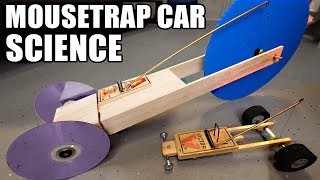
Short Summary
Main recommendation: To build a winning mousetrap car, design around mechanical advantage, friction reduction, light weight, and low rotational inertia, then test and tweak the design rather than relying on preconceived notions like CD wheels. The right balance depends on whether the goal is long distance (aim for the smallest possible force over the longest distance) or speed/precision (aim for a short, powerful burst of energy).
Key Points
- Mechanical advantage is the ratio of output force to input force; trading force for distance is the core principle, and it applies to the car's lever arm, wheel-to-axle ratio, and pulleys.
- For long-distance cars, a longer lever arm slows the car and spreads the spring's energy over more distance, which Al's tests showed beat shorter lever arms (the long-arm car reached 30 feet, the short-arm car lost its early lead).
- Friction is the biggest enemy: reducing axle friction with graphite powder, then ball bearings, took the long-arm car from 30 feet to a new record of 50 feet.
- Keep the car lightweight, because extra mass adds friction and makes the car harder to accelerate, and an overly large car with a super long lever arm performed worse than a shorter one.
- Big wheels store energy as rotational inertia, which wastes some spring energy, so the most efficient design uses reasonable-size wheels and transfers energy directly into forward motion.
- For speed races, the goal is a short burst of energy near mechanical advantage of about 1, with good rear-wheel traction so wheels do not slip.
Details Worth Noting
- Concrete instructions:
- Calculate the mechanical advantage of your design, using the ratio of lever arm length to the spring arm, and the wheel diameter to axle diameter.
- For a long-distance car, use a long lever arm with CD wheels to get roughly a 1:360 mechanical advantage, then add ball bearings at the axles or apply graphite to reduce friction. The video suggests this combination can perform well even if you only have one hour to build.
- Test with cars that differ in only one variable (such as lever arm length) to find the best setting for your design, since optimization is the key.
- For speed races, incrementally thicken the rear axle with tape until the rear wheels just begin to slip, then stop, since slipping wastes energy.
- Use slow-motion video on a phone to check whether the wheels are slipping.
- Soak bearings in WD-40 to remove grease, since the grease only adds drag for lightweight cars.
- Use lightweight foam wheels and a lightweight car body for speed and precision races.
- For the 600-foot world record design, a pulley in the middle of the drivetrain (lever to pulley to wheels) gave a mechanical advantage of about 1:4,608, equivalent to a 16-foot lever arm, without the extra weight.
- In a forward-and-return precision competition (15 feet forward, return, stop at the start point), direction can be switched by winding the axle in the opposite direction halfway through, and stopping at a point can be controlled with a wing nut on a threaded axle.
- The winning team in that precision competition used ball bearings, small foam wheels, and an aluminum car body, and tested and tweaked their design for six months.
- The video notes that for the 15-foot-forward-and-return precision course, the extra weight of aluminum was an acceptable tradeoff because there was enough spring energy for the shorter distance.
Bottom Line
Mousetrap car performance is an optimization problem: the best design balances mechanical advantage, friction, weight, and rotational inertia for the specific race goal, and testing matters more than assumptions about what designs should work.