digest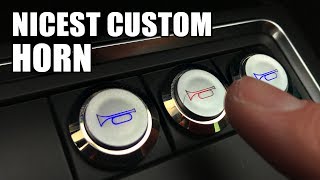
Short Summary
Main recommendation: Add a custom, quieter "courtesy honk" button to your car that plays a short, friendly double chirp, so you can communicate with other drivers without the aggressive sound of a normal horn. Mark Rober built his by wiring an Adafruit soundboard, buttons, an amplifier, and a PA speaker into his Jetta's dashboard, while keeping the standard horn for emergencies.
Key Points
- The video argues that cars have only two built-in communication tools, the turn signal and the horn, and the horn is too one-dimensional for everyday, non-emergency messages.
- Mark says that about 99% of the time he personally uses his horn, it's to nudge a distracted driver, such as one still on their phone at a green light, rather than to prevent a crash.
- A normal horn sounds angry when used at a light, and a quick tap often doesn't register because it cuts off too fast.
- The courtesy honk works for drifting cars, getting attention, drive-thru or traffic movement, and saying thank you.
- A separate, extra-nice sound is designed for pedestrians who are not in a car, and a final, very loud button is reserved for extreme situations.
Details Worth Noting
- Concrete instructions: Buy an Adafruit soundboard (about $27) that accepts sound effects uploaded by USB without programming, plus three horn-style buttons (about $7 each) to trigger the sounds.
- Concrete instructions: Power the soundboard from the car's cigarette lighter socket through a 12V to 5V power inverter to get the correct voltage.
- Concrete instructions: Connect the soundboard's 3.5 mm audio output to an amplifier (about $13) to boost the volume, then connect the amplifier to a PA speaker (about $13).
- Concrete instructions: Mount the buttons in the dash, route wiring through the dash to the speaker, and mount the speaker to the frame under the hood.
- Concrete instructions: For a joking 'extreme situations' final button, the video uses a train or semi-truck style horn system fed by a compressor that fills an air tank to 120 PSI.
- Bob's version is intentionally more temporary, while Mark wanted his own build to be more permanent and installed in the dash; Bob, from the I Like To Make Stuff channel, has a separate video covering a custom horn build in more detail.
- The creator suggests this kind of smaller courtesy button should be a standard feature on all cars, with the big horn kept for emergencies.
Bottom Line
A quieter, custom courtesy horn can make everyday driver-to-driver communication friendlier and less confrontational, and the video shows it can be built from inexpensive off-the-shelf parts.