digest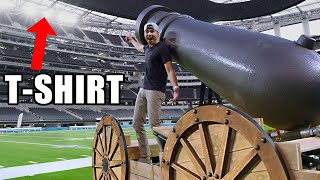
Short Summary
Main recommendation: Build a high-pressure air-powered T-shirt cannon, and use a design built around a larger accumulator tank, a longer barrel, a straight-through connecting tube, and a parachute-release system to launch shirts over long distances. The video shows that a real gunpowder cannon was far too powerful for a stadium T-shirt toss, so the team scaled back to compressed air and tuned the power down, but even at reduced power the final shot flew out of the stadium entirely, over the top row.
Key Points
- A real Civil War-style gunpowder cannon was tested first, but its force was far beyond what a stadium crowd toss would allow, so the team switched to compressed air.
- The first air cannon attempts fell short of the target seat, and a bag tear and damaged tape showed the payload needed reinforcement.
- Anthony, a young engineer and Lego ventilator inventor, proposed the key fixes that made the cannon reach the target: a larger pressure tank, a longer barrel, a straight connecting tube, and a Kevlar bag with a time-delayed parachute.
- A test the day before at reduced pressure hit the top row of SoFi Stadium, but on game day at halftime the actual shot at the same reduced power flew out of the stadium and through the roof.
- The reveal at halftime at the Jimmy Kimmel Bowl showed the shirt flying clean out of the stadium and through the roof, even though they had dialed power down to a quarter to stay within the lawyers' limits.
Details Worth Noting
- Concrete instructions:
- Use a high-pressure tank to fill an accumulator tank; open a valve to release the compressed air down the barrel behind the shirt.
- Make the accumulator tank larger so the air pressure is sustained on the shirt instead of producing a brief poof.
- Lengthen the barrel so the payload can reach higher speed, as rifles do compared with handguns.
- Replace the necked-down connecting tube with one that goes straight to the final barrel diameter so air is not restricted and exits faster.
- Reinforce the payload bag with Kevlar and add a parachute that deploys after a set time delay to create drag and protect the bag.
- Test at reduced pressure first, starting around one third of full power, then increase only as safety allows.
- The final setup used an eight-inch cannon barrel, a 13-pound mortar with a parachute, and 500 PSI of pressure.
- Early tests used a three-pound rag ball and an eight-pound payload, roughly a gallon of milk in weight.
- The stadium limit set by lawyers was about one quarter of full pressure, which still hit the top row seat.
Bottom Line
A stadium-scale shirt launcher is practical with compressed air and smart design choices, but even careful, reduced-power testing couldn't fully predict the final result, since the halftime shot still overshot the stadium.