digest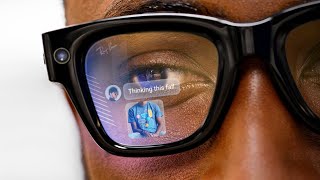
Short Summary
Main recommendation: Meta's Ray-Ban Display smart glasses are now a genuinely usable product, and Marques Brownlee considers them the best smart glasses with a screen he has tried, though the keynote demos were poor. They cost $800, have a monocular full-color display in the right eye, and are controlled by a wrist-worn neural band that reads muscle signals. The glasses are a major leap from the 10,000-dollar Orion prototype shown ten months earlier.
Key Points
- The display is monocular, shown only in the right eye, positioned slightly low and to the right of center, with 42 pixels per degree and up to 5,000 nits of brightness for outdoor use.
- Light leak, which made Orion's screen visible to bystanders, is nearly gone; from most angles it is hard to tell someone is reading the display.
- Text input by drawing letters in midair with the neural band is now a real feature and was the most reliable text input he tested, with whole sentences written first try.
- The glasses are self-contained with no separate computer puck, weigh 69 grams, and come in black or sand with a matching neural band.
- The display adds a visible viewfinder, video call self-view for the other person, turn-by-turn maps that rotate with head direction, and live captioning and translation of speech in front of the wearer.
- Every core app is Meta's own (WhatsApp, Meta's maps, Instagram Reels), and there is no app store at launch.
Details Worth Noting
- Concrete instructions: To control the glasses, use the neural band: scroll up or down with gestures, select, go forward or back, and adjust volume by pinching in the air and twisting slowly. Gestures are quick to memorize and can be made discreetly. To type, draw letters in midair with your hand. To use live subtitles, the beamforming microphones listen to whatever is in front of you and display the text on the HUD; for foreign speech, enable live translation. The charging case folds flat in about two seconds and holds enough battery for four more charges, or holds the glasses inside.
- The price is $800, comparable to a phone, and Marques suspects Meta may be losing money on the hardware to get it into people's hands.
- Privacy questions remain about what data is collected and how it is used, since the product is from Meta.
- Marques expects a wave of user content and competing smart glasses from Samsung and Google within months.
- The keynote demos went poorly, which he says will not help convince people, though he credits Meta for doing live demos rather than faking them.
Bottom Line
The Ray-Ban Display shows that smart glasses with a usable heads-up display have moved from prototype to purchasable product, though closed first-party apps and privacy trade-offs remain significant.