digest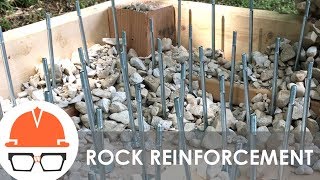
Short Summary
Main recommendation: Tunnels in soil need a permanent lining of steel or concrete to transfer the load of the material above, while tunnels in jointed rock can often be stabilized with rock bolts, a cheaper reinforcement method. The video explains that excavation removes compressive support, creating tensile stress that soil cannot resist but rock can partly resist until jointing weakens it.
Key Points
- Rock and soil carry load from the weight above; excavating a tunnel removes that compression and creates tension in the material above the opening.
- Soil has no real tensile strength; its strength comes from friction between particles, which disappears when those particles are pulled apart, so soil tunnels usually require lining.
- Rock has more strength than soil and can transfer forces around a tunnel, but most subsurface rock has joints, which have no tensile strength and make jointed rock behave more like soil with larger particles.
- Rock bolts (typically steel bars or bolts) are tensioned into drilled holes and anchored by wedge devices or grout, creating a zone of compression that lets fractured rock act as a continuous, tension-resisting mass.
- Rock bolts are most practical in jointed rock, where bolts can be spaced farther apart, and are not suited to gravel or other soil-like material, where lining is the better choice.
Details Worth Noting
- Concrete instructions: Rock bolts are installed by drilling into the native rock in a grid-like pattern along the tunnel, inserting the bolt, securing its end with a wedge device or grout (similar to an anchor in concrete), then tightening the nut and washer to tension it. Temporary shoring must hold the roof until the bolts are installed.
- In the demonstration, bolts used large fender washers to spread the load, and the tensioned bolts let a gravel mass span the gap and support the host's weight.
- The video cites the 2010 Chile mining accident, where 33 men were trapped for more than two months, as an example of the danger of unstable excavation.
- The narrator notes that rock bolting is a form of reinforcement comparable to post-tension reinforcement used in some concrete structures.
Bottom Line
Whether a tunnel needs a full lining depends mainly on the material: soil almost always needs it, while jointed rock can often be stabilized more cheaply with tensioned rock bolts.