 digest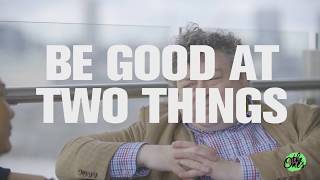
Short Summary
Main recommendation: Be good at two things that are interconnected, rather than building a single linear career, because modern job roles change quickly and breadth gives versatility. Rory Sutherland argues that good work comes from understanding human psychology first and only then choosing media, and that curiosity is the trait he most looks for in hires.
Key Points
- Many current job titles, such as "head of content," did not exist when Sutherland joined the industry, so rigid career planning is less realistic than it used to be.
- Early-career randomness pays off later by building versatility and breadth; he says even being a poor account person taught him things still useful today.
- Employers often hire to fill positions rather than hiring people and shaping roles around them, which he calls one of the worst aspects of employment.
- Recruitment that applies identical criteria to everyone tends to produce homogeneous teams, and mixed backgrounds are essential to how an agency functions.
- Curiosity is the one quality he always looks for, and a fundamental lack of curiosity would be a deal-breaker for a creative role.
- Problems that look like media problems are often human psychology problems; the advice is to understand motivation and decision-making first, then decide which media might fit.
Details Worth Noting
- Concrete instructions:
- Take some deliberate randomness early in your career, trying related but different fields, so you build breadth alongside depth in one area.
- When judging an ad or campaign, check it against how ordinary people outside the industry will read it, not only how other professionals do.
- Recognize that on social media, a few extreme voices can be amplified by mainstream media into an apparent majority opinion, so do not over-react to a small number of complaints.
- Direct your attention deliberately, since you cannot fully control what you feel is important but can change your priorities by changing where you look.
- Build a workplace culture where failure and stupid suggestions are tolerated, because that is what allows good ideas to surface.
- The host describes Sutherland's path as non-linear: he was named the worst graduate trainee Ogilvy ever hired and was fired from planning and moved to creative; Sutherland adds that he reapplied, and later became a copywriter, executive creative director of Ogilvy One, and vice-chairman of Ogilvy UK.
- Discussing the Pepsi ad involving Kylie Jenner (raised by the host), Sutherland notes that issue-based advertising walks a fine line, and explains that a small number of extreme objectors on Twitter can be amplified by mainstream media into appearing like a widespread, mainstream problem.
- He argues that human actions often precede the reasons we give for them, so people's stated reasoning does not reliably match the actual cognitive process.
- As a half-joking aside about fashion pressure on women, he suggests everyone could wear plain overalls (like a Bond villain's henchmen) for four days a week, saving time, while still dressing up on a fifth day.
Bottom Line
Aim for depth in one area combined with breadth across related fields, and value curiosity and mixed backgrounds, because adaptability matters more than a neatly planned career path.


