digest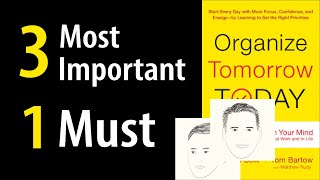
Short Summary
Main recommendation: Organize tomorrow today by writing down your three most important tasks plus one "must" task before lunch, then executing that plan first thing the next morning while ignoring results and focusing on effort and planning. The video frames this as the way to maximize productive time, using John Wooden's approach of concentrating on hard work and intelligent planning rather than outcomes.
Key Points
- Focus on process rather than results: Wooden's advice was to ignore winning streaks and losing streaks and concentrate on hard work and intelligent planning, since wins naturally follow good execution.
- Prioritize before the day starts: Identifying the top tasks a day in advance lets you work on high-value items before meetings, emails, and urgent problems take over, and lets your brain work on them overnight.
- Use the "rainbow basketball" analogy: Most tasks are worth one point, while the three most important tasks are worth 10 points each, so they should be grabbed first.
- Choose tasks like an orange farmer: Balance short-term revenue (collecting fruit, such as near-term results) with long-term revenue (cultivating trees, such as building skills or new opportunities).
- Expect the day to deviate from plan: The video says plans often break down, so it recommends recovery drills rather than abandoning the process.
Details Worth Noting
- Concrete instructions:
- Before lunch today, take five minutes and handwrite the three most important things to do tomorrow, and put a star beside the one task that must get done. Handwriting, rather than typing on a phone, is said to activate the brain more and improve overnight processing.
- Ask two questions when choosing the three tasks: (1) What can I do tomorrow to yield the best short-term results (for example, improving chances in an upcoming competition, exam, or sales release)? (2) What can I do tomorrow to create the most future opportunities (for example, practicing a skill, prototyping a product idea, or starting to outsource work)?
- Next to all three tasks, write an estimated completion time.
- Expect the day to take longer than planned: assume less energy, twice as many emails, and tasks taking twice as long.
- When momentum is lost, take a 100-second timeout: do a 15-second centering breath (inhale six seconds, hold two, exhale seven), repeat an identity statement of three strengths (for example, "I am driven. I am relentless. I am seriously focused."), name three done-wells from the last 24 hours, name three will-dos for the next 24 hours, repeat the identity statement, and finish with another 15-second centering breath.
- After the timeout, do the "ask and chop": ask "What is the most important thing I can get done next?" and visualize cutting off one easy first action to restart.
- The video cites Wooden's father giving him a card reading "make each day your masterpiece," which Wooden carried until his death in 2010.
- The video cites Bill Walsh's line, "if you do your job, the score takes care of itself," and Mike Tyson's line about everyone having a plan until they get punched in the mouth.
Bottom Line
Productivity comes from deciding your most important work the day before and starting on it immediately, then recovering quickly when the day goes off track instead of worrying about outcomes.