digest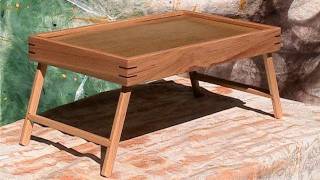
Short Summary
Main recommendation: Build a laptop-in-bed tray (a breakfast-in-bed table adapted for a laptop) out of oak, using purple heart splines in the miter joints and folding dowel-hinged legs, so the laptop sits off the lap and away from heat-trapping blankets. The host presents it as a woodworking project for a viewer's request, with the main design choices explained as he builds it.
Key Points
- The tray was requested by Daniel Posong in Brazil, who said it gets very cold where he lives and he likes to stay in bed with his laptop; using a laptop on the lap can overheat it due to insufficient fan ventilation.
- The host, who does not usually eat breakfast in bed, explains that the design is for a laptop rather than food.
- Miter joints alone are too weak for end grain under the stress of the folding legs, so purple heart splines were added to reinforce the corners.
- Legs use snug-fit 3/8-inch dowels so they stay in position when folded for storage.
- The leg hinge location was found by trial with a nail held in a drilled support piece against a mockup side piece made of cheap pine, then marked where it fit best.
Details Worth Noting
- Concrete instructions:
- Build the frame and legs from 3/4-inch thick oak; the tray panel is 1/4-inch plywood floated in grooves; the legs are joined with dowels.
- Mock up the leg assembly in cheap pine first to find the hinge point: drill a hole in the support piece, hold a nail in it against the side piece at different spots, and mark the side piece where the nail fits best. The leg should hinge there, swing past vertical, and rest against the tray side.
- Cut matching dados on the cross piece with the drill press stop block; move the stop block to the other side of the fence without moving the fence to cut the opposite holes at the same distance.
- Round over and sand all leg edges and inside edges smooth, since sharp edges are uncomfortable in bed.
- Use 3/8-inch snug-fit dowels (the darker ones, not the freely swinging lighter ones) for the legs so they hold position.
- Test-fit the cross piece and dowel before gluing, and dry-fit the glue-up because the side pegs must go in at the same time as the tray.
- Make a spline-cutting jig: a base board with two boards set at 90 degrees, screwed and glued, set flush against the rip fence. Test on scrap first so the slot does not cut through the corner. Glue in the purple heart splines.
- Finish with several coats of glossy lacquer.
- Set the height by sitting in bed first to find a comfortable clearance so the legs do not hit or jostle the tray. The host's tray is 7.5 inches high; Daniel's is 6.5 inches.
- The tray can also be used as a breakfast-in-bed tray, though the host notes crumbs will end up in the bed.
- The host says the bed-tray concept is unfamiliar to him and he prefers eating breakfast in a chair.
Bottom Line
A laptop tray for bed is a practical woodworking build where joint strength and leg height are the critical design decisions, not just the tray's appearance.