digest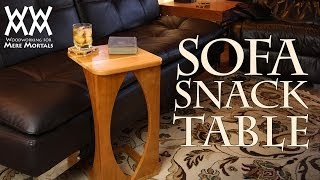
Short Summary
Main recommendation: Build a sofa snack table from solid lumber with a plywood core and edge banding, using glued, pocket-hole-assembled sections, a template-cut curve, and a spray lacquer finish. The video presents this as a living-room sofa table.
Key Points
- The top is made from solid lumber glued up with biscuits to keep the boards aligned and flat while drying.
- The curved base pieces are cut from oversized plywood braces, temporarily screwed and taped together so they can be sanded identically.
- The corners are butt-joined rather than mitered, because 45° miters on a piece this long would likely leave gaps with the speaker's setup.
- Iron-on edge banding is applied to plywood so it looks like solid lumber.
Details Worth Noting
- Concrete instructions:
- Glue up the top boards first and let them dry, using biscuits and flat weights to keep them aligned.
- Square the board edges on a router, moving one half of the fence forward slightly so boards fit with no gaps.
- Oversize the four plywood braces, screw them together, and use double-sided tape in the middle where cuts will remove the screws.
- Attach the printed cutting template (three sheets) with spray adhesive, then cut the curve on a band saw.
- Cut two sides 5 in wide and two sides 5 3/4 in wide so the corners butt together, glue the narrower pieces to the wider ones, and iron on edge banding first.
- Join sections with glue and screws through pocket holes; cut pocket holes in the 1 1/2 in wide base strips and assemble the same way.
- Sand everything smooth, cut the top to final size, round over the corners, then drill pocket holes to attach the base and top.
- Clamp the base in position long enough to drive the screws, flip it, attach the top, and protect with spray lacquer.
- Adjust the dimensions depending on sofa size, the space beneath the sofa, and how far back you want the table to sit.
- Double-sided carpet tape proved stronger than expected, holding the braces together during sanding.
Bottom Line
This is a practical, beginner-friendly sofa table project that uses plywood with solid-wood-look edging, and the design is easy to adapt to your own couch.