digest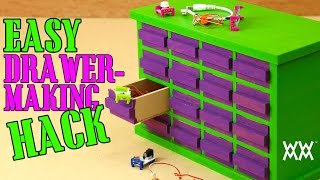
Short Summary
Main recommendation: build the drawers first, then construct the cabinet around them, using a single long MDF board cut with dado blades to form the fronts and backs of all 16 drawers. Steve Ramsey demonstrates how to register repeated grooves with a stop block and key so the dividers line up square.
Key Points
- Starting with the drawers ensures the cabinet is sized to fit them, rather than the usual approach of building the cabinet and then fitting drawers to it.
- A single long MDF board serves as both the drawer fronts and backs, cut into pieces with a 1/2 in wide stack of dado blades after grooves are cut along its length.
- Repeatable spacing comes from a stop block and a 1/8 in thick strip hot-glued in place as a key, so each groove is cut at a consistent 2 in interval.
- Horizontal dividers are sized using quarter-inch spacers plus a playing card for breathing room, and a test piece is used to tune the divider slot fit before cutting the rest.
- The 1/8 in hardboard bottoms slide into a rabbet, and the notches in the side pieces keep all dividers aligned square.
Details Worth Noting
- Concrete instructions:
- Cut a 1/2 in wide rabbet on one end of the MDF board, then cut a 2 1/2 in block to set the groove spacing.
- Slide the block up against the dado blade edge and lock it as a stop block; hot-glue a 1/8 in wide strip as a key using the stop block and the rabbet.
- Remove the block once dry and cut each groove by sliding the board over the key each time.
- Glue a 1/8 in hardboard panel into the rabbet for the drawer bottoms, and make a couple of passes over the dado blades for the drawer pulls.
- Cut as close to center as possible on the first drawer, set a stop block, then adjust the fence for equal cuts across the remaining drawers.
- For horizontal dividers, use quarter-inch spacers and a playing card between drawers for clearance; divider depth equals drawer depth.
- For divider slots, use a stop block on the fence with playing cards as spacers, using a 1/4 in dado stack raised to full height and cut to the halfway point on each board.
- Cut the center slot with spacers in the existing slots, then fine-tune by moving the fence slightly; the host suggests that cutting the center slot first, then the outside slots, might work better.
- For vertical dividers, cut all slots on one long strip using a key piece and a drawer as a spacer, adding the thickness of four playing cards to the fence.
- Cut side-piece grooves halfway through 1/2 in MDF, then glue 1/2 in boards on top and bottom, and glue a hardboard back.
- The cabinet is built around the drawers, so the drawer dimensions determine the cabinet size.
- The host jokingly compares the cost to a store-bought small-parts cabinet at roughly $15 to $20, joking that making your own costs about twice that.
Bottom Line
Building the drawers first and using a stop-block-and-key system with dado blades lets you cut 16 matching drawers and dividers efficiently, with the free plans in the description as a starting point.