digest
Short Summary
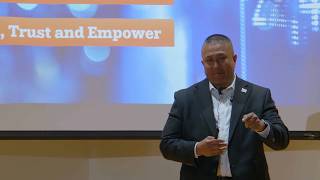
Main recommendation: Don't put off hard conversations, and recognize how much identity we attach to what people do; the speaker's story of leaving marketing to become a magician illustrates both. The talk is a demonstration-led presentation of mentalism and magic tricks, used to show how attention and assumptions shape our perception of others.
Key Points
- The speaker quit a marketing career at the start of the year because he wanted to pursue magic, a childhood ambition he had avoided discussing with his parents.
- His seven-year-old daughter's remark, "Huh, you don't have a job," shows how strongly people link identity to occupation.
- Knowing someone's job makes listeners fill in assumptions, such as a lawyer prompting caution or an accountant suggesting a love of numbers.
- Audience-driven demonstrations (an imagined card, an imagined water disappearing, a guessed cat name, and a shared occupation) are used to show how attention and suggestion work.
- The speaker argues that every minute matters, closing with a group calculation that ties back to the theme of shared moments.
Details Worth Noting
- Concrete instructions: The transcript gives no step-by-step method a viewer could replicate outside the performance. The only actionable advice is the speaker's general encouragement not to put off hard conversations with parents or family.
- The speaker says a 3x3 Rubik's cube has about 43 quintillion combinations, and he claimed to solve one in five seconds in the demonstration (a mentalism trick), noting he was one count off.
- In the cat-name demonstration, the speaker narrowed the first letter by running through the alphabet and noticing a slight change in the volunteer's expression around the letter "S" (the word was ultimately revealed as 'Layla').
- In the occupation demonstration, the volunteer Abby picked "engineer" and the speaker's partner Tim wrote down "Abby," showing the trick relies on participants' cooperation and on the performer's presentation rather than on any described technique.
- The closing calculation used three random three-digit numbers from the audience, and the speaker used a mentalism trick to make the result match the date, which he stated as the 1st of August, 2026.
Bottom Line
The talk uses playful magic to argue that our assumptions about people, based on what they do, can be as misleading as a magic trick, and that moments of connection are worth making count.