digest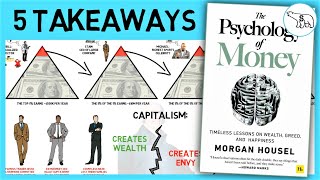
Short Summary
Main recommendation: Treat your behavior with money as more important than intelligence, and build investing habits around accepting volatility, avoiding envy, respecting different financial perspectives, preparing for unforeseeable disasters, and staying skeptical of pessimism-driven narratives. The video presents these five ideas as takeaways from Morgan Housel's book The Psychology of Money, illustrated with the story of Ronald Read, a janitor who died in 2014 with about $8 million in savings through consistent saving and compounding.
Key Points
- Volatility is the price of high long-term stock market returns; investors who cannot tolerate sharp drops, such as an 80% fall in Netflix's stock during 2011, should not aim for maximum returns.
- Even a plain S&P 500 index fund bought in 1980 faced about 13 years combined spent 20% below its high and about 8 months spent 50% below it.
- Social comparison drives envy: a person earning $500,000 (top 1% in the US) can feel poor next to a neighbor earning $10 million, who is in turn dwarfed by Michael Jordan's roughly $2 billion fortune.
- People's spending choices reflect different backgrounds and perspectives; lower-income households spend more than $400 per year on lottery tickets, which the video frames as buying into a dream rather than as pure foolishness.
- Black Swan events (per Nassim Taleb) are outliers with extreme impact that seem obvious only in hindsight, such as the Great Depression, World War II, the 2008 financial crisis, and Covid-19.
- Missing the 4 best-performing stock market days over 20 years in the S&P 500 would have reduced the return from 291% to 164%.
- Humans give pessimism more weight than optimism, partly because losses loom larger than gains (per Daniel Kahneman) and setbacks happen faster than progress.
Details Worth Noting
- Concrete instructions: Accept that all investors will experience volatility and plan to stay the course through downturns rather than selling when net worth drops (e.g., 20% in a week) after earnings disappoint.
- Concrete instructions: Before copying a portfolio or strategy, check whether it fits your own goals and risk profile; a billionaire's focus on "staying rich" differs from a younger investor's focus on "getting rich."
- Concrete instructions: Say no to investments outside your circle of competence, as the speaker did with GameStop.
- Concrete instructions: Prepare mentally and financially for disasters you cannot foresee instead of trying to react before everyone else, and stop relying on macro projections.
- Concrete instructions: Be careful when taking investment advice, and be aware that pessimistic arguments may feel more persuasive than optimistic ones.
- The lottery example cites households earning the least in the US spending more than $400 per year on tickets, while more than a third of Americans cannot cover a $400 emergency.
- The Netflix example describes an all-in portfolio losing much of its value in 2011; the speaker raises the question of what one would tell one's spouse and kids in that situation.
- The video credits Hans Rosling's view that "the world is better than you think" and cites rising life expectancy, cheaper sustainable energy, and growing computing power as reasons for optimism.
Bottom Line
Long-term investing success depends less on intelligence than on tolerating volatility, resisting envy, staying within your own goals and circle of competence, and preparing for shocks you cannot predict.