 digest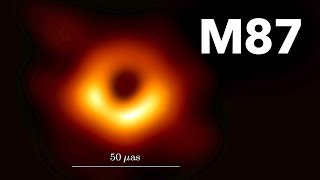
Short Summary
Main recommendation: The video's central conclusion is that the Event Horizon Telescope Collaboration produced the first image of a black hole, the supermassive black hole at the center of galaxy M87, released April 10, 2019. The image was made possible by combining eight telescopes across the globe into a virtual Earth-sized instrument, and it confirms that black holes exist.
Key Points
- The image shows plasma orbiting the M87 black hole; the bright side is brighter because the plasma moves toward us near light speed, an effect called relativistic beaming.
- Scientists determined from the images that the plasma orbits clockwise, taking roughly two days per orbit.
- The image was made with 1.3 millimeter radio waves, which can reach close to the event horizon and pass through the accretion disk and interstellar dust.
- The black hole's mass is about 6.5 billion times the Sun's, its shadow is nearly the size of our solar system, and it lies 53.5 million light years away.
- The result matches Einstein's general theory of relativity, published over a century ago, in the strongest gravity tested so far.
Details Worth Noting
- Concrete instructions: No step-by-step instructions are given for the viewer. The only actionable point is that the video links the team's work in its description.
- The black hole's shadow spans about 40 micro arc seconds, roughly the limit of what current technology can resolve, which explains the fuzzy image.
- Achieving that resolution required a telescope the size of Earth, which was impractical, so eight telescopes observed simultaneously while Earth's rotation filled in the simulated aperture.
- The jets extend at least 5,000 light years, and one points almost directly at Earth; Hubble imaging shows its approaching side is brighter due to relativistic beaming.
- The Sagittarius A* black hole at the Milky Way's center was also observed, but its image had not been released; it is about 26,000 light years away, has about 4 million solar masses, and its matter orbits every 4 to 30 minutes, making it more variable over time and thus harder to image.
Bottom Line
The M87 image is a landmark that confirms black holes exist and validates general relativity, achieved by coordinating a global network of telescopes to mimic an Earth-sized instrument.




