digest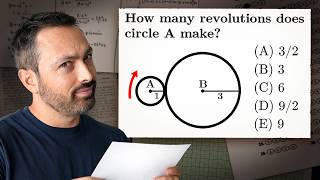
Short Summary
Main recommendation: The correct answer to the 1982 SAT question 17 is four rotations, not three, because the outer circle must rotate one extra time to follow its circular path around the inner circle. The question was flawed, the College Board nullified it after three students challenged it, and the video uses this "coin rotation paradox" to explain why the distance a rolling circle's center travels always equals the amount it rotates.
Key Points
- The intuitive answer of three (based on circumference ratio) is wrong; the test writers themselves made this error, so no listed option was correct.
- Three students, Shivan Kartha, Bruce Taub, and Doug Jungreis, wrote to the College Board, and the question was discounted after the College Board publicly admitted the mistake a few weeks later.
- The coin rotation paradox: rolling one coin fully around an identical coin makes it rotate twice, not once, even though the coins are exactly the same size.
- The rotation count can be confirmed from the perspective of the inner circle, or by treating the path as a straight line and adding one rotation for the circular path.
- The general rule: the distance traveled by a rolling circle's center equals the amount it rotates, which gives N+1 rotations around the outside, N-1 inside, and N on a flat line.
- The "revolution" wording was ambiguous; under the astronomical definition, circle A only revolves once around circle B.
Details Worth Noting
- Concrete instructions: To check the answer, find the ratio of the circumferences of the larger and smaller circles, then add one rotation for a circle rolling around the outside (or subtract one for rolling inside). To verify, count rotations from the perspective of the larger circle looking out, or wrap the larger circle's circumference in ribbon and lay it straight to see the extra rotation. Use the general method: find the distance the center travels and divide by the small circle's circumference.
- The question's diagram was to scale despite the disclaimer, which the video notes as a useful general tip since standardized test images are usually to scale even when labeled otherwise.
- Scoring impact: removing the question shifted scores up or down by 10 points out of 800, which can matter for some scholarships and admissions cutoffs. Rescoring reportedly cost the testing service over $100,000.
- The same principle explains sidereal versus solar time: a sidereal year has about 366.24 days and a sidereal day is about 23 hours, 56 minutes, and four seconds, which astronomers use for telescopes and geostationary satellites.
- After COVID-19, nearly 80% of US undergraduate colleges reportedly stopped requiring standardized testing.
Bottom Line
The SAT question 17 error is a clear example of how a seemingly obvious circumference-ratio answer can be wrong, and the rolling-circle principle it reveals explains everyday timekeeping in astronomy.