digest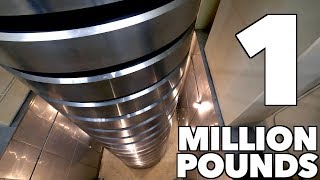
Short Summary
Main recommendation: Calibrate large force sensors with physically known masses rather than relying on extrapolation or expert opinion, because the video argues that "one physical test is worth a thousand expert opinions." The video profiles a dead weight machine at a national measurement facility that applies up to 4,448,222 newtons (1,000,000 pounds-force) using 20 calibrated 50,000-pound masses to calibrate the force transducers used in jet engine and rocket testing.
Key Points
- Large aerospace forces, such as jet engine thrust (about 570,000 newtons record) and Saturn V thrust (about 33,360,000 newtons), must be measured with calibrated sensors because the forces are too large to estimate reliably.
- The machine stacks 20 masses of 50,000 pounds each; hanging weights create a precisely known vertical force that is used to calibrate force transducers.
- Uncertainty is kept extremely low: the facility guarantees accuracy of 0.0005% (five parts per million), or about 5 pounds at full 1,000,000-pound load.
- Calibration is traced back to the kilogram definition through the US fundamental mass standard K20, by comparing known weights against progressively larger ones.
- The speaker frames the machine as one of a kind and says that, as far as he knows from asking visitors, these may be the largest mass objects ever calibrated anywhere, though he frames it as 'going out on a limb.'
Details Worth Noting
- Concrete instructions: The video describes the calibration procedure as follows. (1) Place a force transducer on the compression head. (2) A hydraulic ram raises the green lifting frame until the transducer contacts the red loading frame. (3) As the frame keeps rising, more 50,000-pound weights become suspended by the sensor, and the transducer readout is calibrated against the known force. (4) The calibrated devices are then installed in test stands, where rockets are fired and forces monitored, for example to confirm "104% of power."
- Weights are first calibrated by comparing K20 with unknown masses, moving from kilograms to pounds (50, 500, 2,500, 10,000, 20,000, and 30,000 pounds) with a floor scale.
- Each 50,000-pound mass is about 50,036.27 pounds, roughly the weight of ten minivans, and its value is known to within a few nickels' worth of difference.
- Corrections are applied for local gravity, which is slightly less than standard gravity and requires about 600 extra pounds, and for air buoyancy, since the masses displace about 125 pounds of air, requiring another 125 pounds to reach the target force.
- The interviewer raises the question of whether a company like Boeing could just calibrate a smaller device and generalize upward, and the speaker responds that physical testing at full scale is preferred over extrapolation, citing the axiom that one physical test is worth a thousand expert opinions.
Bottom Line
Accurate measurement of very large forces depends on physically calibrated weights traced to fundamental standards, with corrections for gravity and buoyancy, rather than estimates or extrapolation.