digest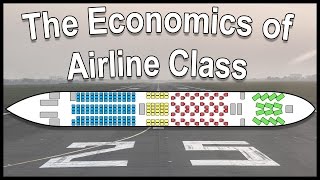
Short Summary
Main recommendation: Airlines make most of their money from premium cabins (first, business, and premium economy), not from economy class, because a small share of passengers generates most of the revenue. The video explains how this model emerged from cost-cutting, price segmentation, and deregulation, and why first class is now being phased out in favor of more business class seats.
Key Points
- On a sample British Airways London Heathrow–Washington Dulles 777 flight, the 40 premium-economy, 48 business, and 14 first-class seats together generate about $550,034, roughly 84% of the flight's revenue from about 45% of passengers.
- The premium-heavy result is partly an artifact of non-stop fares between high-income, high-demand cities; connecting passengers pay much less, but the revenue split is still roughly similar.
- Early commercial aviation had essentially only premium travel because flying itself was the luxury; classes emerged as costs fell, so the real trend is cutting costs to let more people fly. The narrator also speculates that space tourism will likely follow the same pattern once it becomes common.
- Airlines have always sold the same flight at different prices to different types of travelers, with the difference mainly in the ticket rules and onboard experience.
- After deregulation (1969–1978) and the Concorde era, airlines segmented passengers into tiers, but the Concorde's failure led to first class being reintroduced selectively; only six of dozens of transatlantic airlines now offer first class.
- First class is shrinking because its cost to operate is high while its price premium over business class is small; the video cites an Etihad A380 example where business class earns more revenue per square foot than first class.
Details Worth Noting
- Concrete instructions: The video gives no step-by-step instructions for passengers or operators. Its actionable takeaway for a traveler is to recognize that fare classes differ mainly in ticket flexibility, advance-purchase rules, and seat space, so cheaper tickets mean less flexibility and comfort.
- Revenue per square foot on the Etihad Abu Dhabi–New York route: economy about $332, business about $605, first class about $403, based on the quoted round-trip fares and seat floor space.
- Example fares from the video: on the London–Washington route, round-trip economy was $876, premium economy $2,633, business $6,723, and first $8,715. Connecting from Stockholm dropped these to $392, $1,150, $3,025, and $5,564.
- Historical example: a 1950 round-trip coach fare between New York and London was $675, roughly $6,800 in inflation-adjusted terms, close to a modern first-class fare on the same route.
- In 1952, one airline sold one-way New York–London tickets for $395 (standard) and $270 (tourist), the same flight, with the cheaper ticket requiring advance purchase and no flexibility.
Bottom Line
Airline profits depend on a small number of high-paying passengers in premium cabins, and the industry's pricing and seating decisions are shaped by how much those passengers will pay for flexibility and comfort.