digest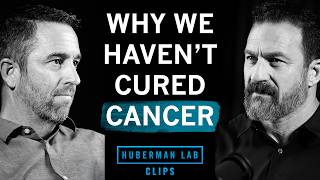
Short Summary
Main recommendation: Treat cancer with combination therapy, using several safe, targeted drugs that hit different features of a tumor's biochemistry so it becomes very hard for cancer cells to resist all of them at once. The speaker argues this is the most promising route toward something approximating a cure, since cancer cells are our own cells, making them hard to kill without harming healthy tissue.
Key Points
- Cancer arises from many pathways, but nearly all cancers involve mutations that drive rapid division and help cells evade the immune system.
- Checkpoint inhibitors (PD1 and PDL1 inhibitors) work by removing the cloak cancer cells use to hide from the immune system, and have produced strong responses in some cancers.
- The Warburg effect (named after Otto Warburg, 1920s) describes cancer cells consuming less oxygen; the speaker explains this reflects cancer cells redirecting resources toward building new cell material rather than burning fuel, not broken mitochondria, as Warburg originally believed.
- Cancer is hard to treat because cancer cells are our own cells, and many of their features overlap with normal stem cells and proliferating cells, which is why chemotherapy causes side effects such as gut-lining damage.
- Drug resistance arises through evolutionary pressure: a drug may kill 99.9% of tumor cells, but the remaining 0.1% can repopulate, which is why tumors can return after remission.
- Drugs targeting specific oncogenic mutations, such as KRAS, hit specific proteins without affecting normal cells, but resistance can still develop.
Details Worth Noting
- Concrete instructions: The transcript gives no step-by-step protocol for patients or viewers. The actionable guidance is strategic: pair several safe, mutation-specific drugs chosen based on the individual tumor's biochemistry, so that resistance to all of them simultaneously becomes very unlikely.
- The speaker draws a direct analogy to HIV, which is managed with triple combination therapy because resistance to all three drugs at once is difficult to acquire.
- The speaker frames the core challenge as killing cancer cells without killing the healthy cells that share their features, such as stem cells and cells lining the gut.
- The discussion of a potential "linchpin" target (such as redirecting pyruvate use) was posed as a question; the transcript does not confirm a specific single cure target.
- The speaker notes that checkpoint inhibitors do not treat every cancer to the same degree, so response varies.
Bottom Line
Cancer's difficulty comes from its close resemblance to healthy cells and its ability to evolve resistance, so the most promising path described is tailoring multiple targeted drugs to each tumor's specific features.