digest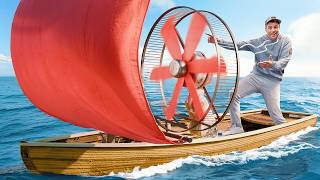
Short Summary
Main recommendation: Treat viral physics demos skeptically and test them yourself, since the video finds the tourist equator sink demo is a scam and that blowing a fan on your own sail cancels out and doesn't move a boat. The video also tests a floating HoverGlide backpack and concludes it's only beneficial on flat, predictable terrain, not rough trails, and uses several physics demos to explain why each claim holds or fails.
Key Points
- The sail-fan test shows that a fan blowing on a sail just cancels itself out, because the sail pushes back with equal force; a boat only moves when the fan pushes against water (a propeller), and a viral leaf-blower-and-umbrella skateboard actually works because the skateboard is secretly electric, not because of the leaf blower or umbrella.
- The equator demo is a scam: the tourist twists the pour at the end to set the swirl direction, and the GPS coordinates show the site is more than a football field south of the true equator.
- Toilets and sinks do not drain opposite ways across the equator; toilet swirl depends on nozzle direction, and the Coriolis effect is far too weak to affect ordinary drains.
- Air has mass: adding air to a balloon made it knock over a sign, which explains why the car's invisible air sloshes forward when braking and pushes a helium balloon backward.
- The moon appears upside down in the Southern Hemisphere and sideways at the equator, and an ellipse's focus points let sound from one focus travel to the other, as in John Quincy Adams's Capitol room.
Details Worth Noting
- Concrete instructions: To test the tourist demo at home, pour water into a sink and finish with a subtle twist in one direction, then twist the opposite way at the end to reverse the swirl; this recreates the whirlpool in both directions.
- Concrete instructions: To test whether air adds mass, inflate the same balloon further and throw it at a sign; the extra air made it knock the sign over.
- Concrete instructions: To test the HoverGlide claim fairly, the host hiked a few miles with a normal backpack, then loaded the same weight into the HoverGlide pack and compared how it felt.
- The HoverGlide design adds about 4 pounds of pulleys, cords, and frames, and it can throw you off balance when out of sync on rough terrain; Mark judged it beneficial only on flat, predictable ground, but not worth the extra weight on rough terrain.
- Rope around the Earth: lifting a rope a foot off the ground everywhere needs about 6.28 extra feet (2π) regardless of circle size, the same as for a basketball.
- The Coriolis effect only becomes noticeable far from the equator, so sink drain direction is driven by sink geometry and residual water motion instead.
Bottom Line
Viral physics claims often sound convincing but fail when tested, so checking the setup and running a simple test yourself is the best way to tell real effects from tricks.