digest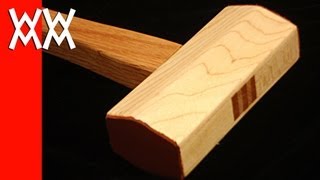
Short Summary
Main recommendation: Build a wood mallet using a tenoned head locked with a wedged tenon, and fill the head with lead weight (fishing sinkers or BBs) for heft. The video presents this as a simple, must-have shop project, shown as a Thor's hammer-style mallet with leather cushioning on each face.
Key Points
- The head is hardwood (maple) with a tenon and wedge system, a construction method the speaker learned from Woodsmith magazine.
- Leather is glued to each face to cushion blows.
- He usually fills the weight holes with lead fishing sinkers, but in this video he tried sand to save money; the sand proved much lighter, so he recommends lead or BBs instead.
- No special tools are needed for the core of the head, though the table saw and a tenoning jig are used for the joinery.
- The speaker has made about four of these mallets since the first one six years ago.
Details Worth Noting
Concrete instructions:
-
Cut a piece of 3/4 in maple about 2.5 in wide and 12 in long; only about 2.5 in on each side is used, the extra length is for holding.
-
Drill one and a half to two inch holes on each side of the head for weight (note: transcript says 'one and a two in holes,' likely meaning about 1.5-2 inch holes).
-
Set the miter gauge to about a 2° angle and cut two wedge-shaped pieces on the table saw, glue them onto a longer piece with the wedge oriented correctly.
-
Clamp the head together and let it cure; fill the holes with lead weight.
-
Tilt the table saw blade to about 15° to chamfer the head edges for the handle.
-
For the handle, glue two oak pieces, make the tenon about 1/8 in larger all around than the mortise to leave room for a shoulder, then fit it with shallow passes on the tenoning jig, raising the blade to the head height.
-
Cut two slots through the tenon for the wedges, lowering the blade slightly so the slots are shorter than the tenon.
-
Cut the wedges from scrap maple with the blade tilted at 2°.
-
The handle shape is left to personal feel; sanding is done until it feels good.
-
Sand was tested as filler and found far too light compared to lead.
-
The video is a short project with no further caveats beyond the weight tip.
Bottom Line
A simple, reusable woodworking project that is worth making, provided the head is weighted with lead rather than sand.