digest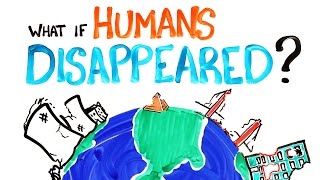
Short Summary
Main recommendation: The video's central answer is that if humans vanished, the first few weeks would be chaotic, but most human-made structures and infrastructure would decay over decades to centuries, while our trash, especially plastics, would outlast us the longest. Within hours, power plants would shut down and livestock would escape, followed by widespread city flooding, fires, and rust-driven decay.
Key Points
- Within hours of humans disappearing, power plants run out of fuel and shut down, and electric fences stop working.
- Over 1.5 billion cows, nearly a billion pigs, and over 20 billion chickens would escape enclosures, with most starving or becoming food for stray dogs and cats.
- Subway tunnels would flood quickly without electric pumps, and many city streets would be overtaken by weeds and vines.
- Most cities would be wiped out by fire, since modern houses, especially in suburbs, are largely timber and would have no firefighters.
- After about 100 years most wood structures would be gone, and steel structures would follow as they rust back into iron oxide without paint and coatings.
- Plastics and vulcanized rubber would persist, leaving microplastics that could be preserved in sedimentary rock for hundreds of millions of years.
Details Worth Noting
- Concrete instructions: None. The transcript is a descriptive scenario and contains no actionable advice to follow.
- Lice and rats are mentioned: body lice and head lice would go extinct, while rats and cockroaches would suffer drastic population declines.
- Camels already roam Australia, and dozens of European songbird species now thrive in North America, showing how species distributions would remain altered.
- Escaped zoo animals could form new wild populations, leading to the possibility of lions on the Great Plains or hippos in South American rivers.
- Deserts would preserve structures and materials much longer, since they lack moisture that speeds rusting and decomposition (the transcript notes everything lasts longer in deserts for this reason).
- The carbon cycle would return CO2 levels to equilibrium after a few thousand years, while local deposits of long-lived chemicals or radioactive material could persist far longer.
Bottom Line
Humans would vanish from the landscape quickly, but their infrastructure, animals, and especially their plastic waste would leave a lasting, altered record on Earth for centuries to millions of years.